 My husband J.L. and I have a daily devotional guide publishing this month called A JOURNEY OF WORDS. You might ask what exactly is a day-to-day devotional and why does anyone need one?
In general, a daily devotional is a Christian religious publication that provides a specific spiritual reading for each calendar day. Reading a daily devotional, along with time in the Bible and in prayer, is one way to give love and honor to God. It’s also a way of remembering to give God a priority in your life every day. It is hard for faith to stay strong or grow without spending quality time with God. The Bible teaches: “Study to shew thyself approved unto God, a workman that needeth not to be ashamed, rightly dividing the word of truth…to be a vessel unto honour, sanctified, and meet for the master’s use, and prepared unto every good work” [II Tmothy 2:15, 21].
 We can rarely grow in knowledge in any subject area without study. A strong knowledgeable faith doesn’t simply fall on us or happen without effort. It comes by giving disciplined, committed time and study to increase in wisdom, understanding, and expertise—just like growing in knowledge in any other subject area. When you spend quality time with God you’ll not only gain more spiritual wisdom and understanding, you’ll grow into a closer, deeper place of faith. Studying to grow in God always has big rewards and blessings. Even the best of church services only offers a small window of time once a week for spiritual growth. And just as one meal a week won’t sustain us physically, one spiritual meal a week won’t either. Spending time with God every day is a needed discipline, good to cultivate, that helps you learn to lean to God to direct your life and path versus learning to your own understanding and the world’s voice and persuasion {Prov 3:5-6]. Joyce Meyer wrote: “If you make time with God your first priority, everything else will fall into place.”
 In a spiritual sense, the word “devotion” in itself refers to the deep love and commitment we give to God in our lives, in time, study, and prayers. If you’re devoted to someone you don’t simply care about them in a part-time, lackadaisical way, you care about them in a full-time, loving, committed way. As an extra plus, when you’re fully committed and devoted to God, He in return is totally devoted to you. Charles Stanley wrote: “God takes full responsibility for the life wholly devoted to Him.” It’s comforting to realize devotion to God is always lovingly returned. That isn’t true of many things and people we give our love and commitment to.
A daily devotional isn’t essential in order to grow in faith, but it can be a help, along with time in church, prayer, and Bible study. Spending time with God benefits every aspect of your life, draws you closer to the Lord, refreshes your soul, gives you guidance for your life, and restores your peace, health, clarity and joy—always a win-win situation.  A sweet quote by Elizabeth George says: “The more time you spend with God, the more you will resemble Him.” We do become more and more like those we associate with, for the good or for the bad. “The key is to keep company only with people who uplift you, whose presence calls forth your best.” [Epictetus] We can be assured that spending quality time with God will always call forth our best.
Our devotional guide, A JOURNEY OF WORDS, is built around the concept that a single word is powerful and when meditated on, can open doors for good and needed change. Many Christians choose a “Word for the Year” to inspire positive growth and thought all year long, but we decided it would be positive—and fun—to have an inspirational word to think about for every day of the year. Each of our daily devotions starts with a “word for the day” and a quote for the day using the day’s word, followed by a devotional teaching linked to that word, and closing with a short prayer and a scripture containing the word again. J.L. and I alternated writing the devotions throughout the book, one day by J.L., one day by myself … and we hope our daily guidebook will help to enrich your faith and impact you for blessing and good.
To close, here is one of the devotionals I wrote that you will find in the book—for April 1st, the publication day for this and my other two spring novels. If you would like an autographed copy of this book, go to our website under Contacts at: “Order Autographed Copies” and you will find two ways you can get this new devotional – and any of our other books – shipped directly to your home. The link is: https://linstepp.com/order-autographed-books/
Have a wonderful April … and a blessed Easter season, … Lin
 APRIL 1 – The Word for the Day is “Shower”
Quote for the Day:
“God made us for one reason: so He could have fellowship with us. It wasn’t that He was lonely or needed us but He made us so He could shower His love upon us.” -Billy Graham
All of us, at one time or another in our lives, have been caught out in a shower. Generally, when this happens we hustle to get in out of the rain. Yet it is often joyous to watch a shower out the window, especially a needed one. It seems as though the branches of the trees seem to reach up to welcome the rain and one can almost hear the grass sigh as it is soaked deeply with the rich, needed rain.
Showers of blessing fall in our lives, in big and small ways, not just occasionally but every day. Sometimes we are mindfully grateful of them and stop to thank God and give Him praise. Other times we run on along our way, almost seeming to take God’s rich blessings for granted. When Jesus healed the ten lepers, only one returned to thank Him [Luke 17:11-18]. Although we get busy and often forget, we know we should thank God daily for His blessings. He is so good to us. The Word reminds us that ‘a faithful man abounds with blessings’ [Proverbs 28:20]. Every day we should always be grateful to God for His love and goodness.
I love the concept in the Bible that ‘God will cause the showers to come down in season on us and that there will be showers of blessing’ [Ezekiel 34:26]. As the rain showers come to bless the earth, God’s showers of blessing and love come to enrich and bless us. “O give thanks unto the Lord, for he is good; for his mercy endureth forever” [1 Chronicles 16:34].
Prayer:
With thankful hearts we offer gratitude today for the showers of blessings that come to us from God our Father.
Scripture of the Day:
“I will cause the shower to come down in his season; there shall be showers of blessing.” – [Ezekiel 34:26]
Note: All photos my own, from royalty free sites, or used only as a part of my author repurposed storyboards shown only for educational and illustrative purposes, acc to the Fair Use Copyright law, Section 107 of the Copyright Act.
 Readers often ask me where I get the ideas for my books. In looking back at over twenty published novels now I think my main answer would be that “places inspire my stories.” It is often while traveling around East Tennessee, hiking in the Smokies, or visiting the beach in South Carolina when ideas for books slip into my heart and mind. Suddenly in those moments I can see book characters walking around in my thoughts, the concept of a new story drifting to life.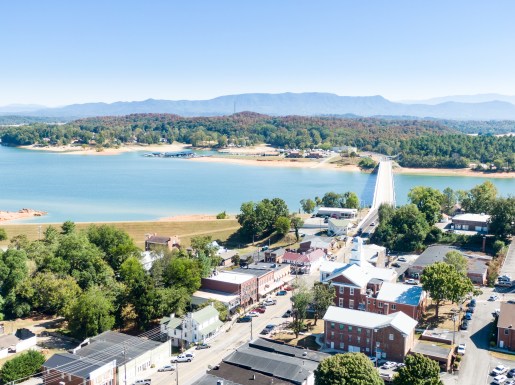
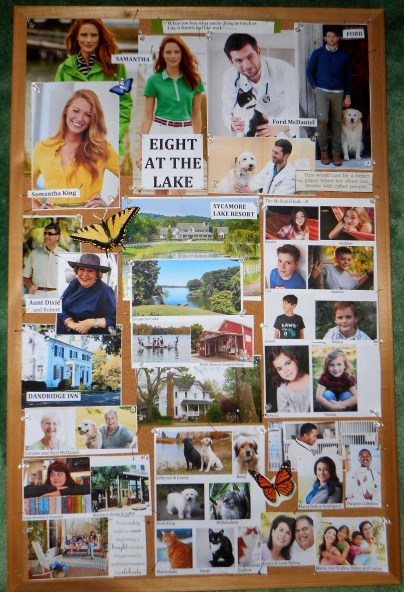 Perhaps this ongoing request fired the idea for the eight children, in EIGHT AT THE LAKE, being raised by Ford McDaniel. Ford is a local veterinarian in Dandridge and part-owner with his father of Sycamore Lake Resort. Quite frankly, Ford has many days himself, when he wonders how in the world he ended up with eight kids to raise. My other major character in this book, Samantha King, grew up in Dandridge at a lovely old Bed & Breakfast belonging to her Aunt Dixie. She and Ford McDaniel have nothing in common. Samantha is a well-known storm chaser and meteorologist with a national weather channel in Atlanta. She travels constantly across the U.S. covering storms, her world an exciting one compared to Ford’s life in a small, quiet town in rural Tennessee. The only reason Samantha is in Dandridge at all is to recover from an accident, and she is already champing at the bit to get back to work as the story begins.
 You’ll find a synopsis of the book on the front page of my website at:
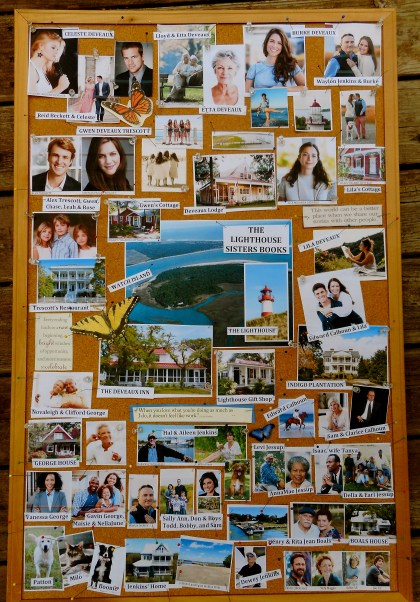 Old maps call the small island at Edisto’s north end, Botany Bay Island, and it took only a small jump of my imagination to imagine a lighthouse and inn sitting there. The entire island had been separated from the mainland of Edisto in Hurricane Gracie and now could only be accessed by boat—a perfect spot for my story idea of four sisters growing up at a lighthouse. Since the name Botany Bay is now so associated with the Botany Bay Wildlife Preserve, I decided to call the island Watch Island in my book, using one of its old names from the past, and I decided to name my fictitious lighthouse after the Deveaux Bank bird sanctuary nearby and after the equally fictitious Deveaux family, who had been keepers at the lighthouse since its earliest days. Not living as close to Edisto as I do to the Smoky Mountains, I gathered more research online, bought history books about the Lowcountry and Edisto, and made extra visits to South Carolina to work on developing the concept for the four books that will be in this new series.
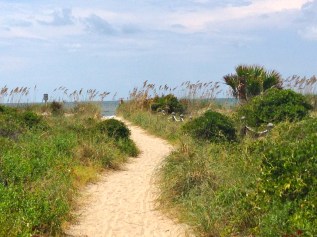 I hope you’ll enjoy taking a trip to the South Carolina coast in the first book in the Lighthouse Sisters series LIGHT THE WAY and also in visiting the mountains and Dandridge in EIGHT AT THE LAKE. “Where are you taking me next year?” one of my readers asked recently. The answer is to Cherokee, North Carolina, in a rich new Mountain Home story titled SEEKING AYITA – and also back to the beach again for the second of the Lighthouse Sisters books titled LIGHTEN MY HEART.
 We often think of February as “the month of love” because Valentine’s Day always falls in the middle of the month on the 14th. People swap cards, candy, flowers, and gifts—and the stores are filled with Valentine displays. But where did these traditions come from?
 Most sources suggest that Valentine’s Day originated as a feast day to honor Saint Valentine of Rome, a priest and early Christian martyr. Pope Gelasius first originated the Feast of Saint Valentine to remember the date of the priest’s death and to honor the good works and miracles performed in his life. On a romantic note, Valentine secretly married young couples when the emperor in his lifetime prohibited young marriage, believing unmarried soldiers fought better. Another legend says Saint Valentine wrote the first valentine greeting to the daughter of his jailor before his execution, signed “Your Valentine.”
 Europeans, and especially the British, began to pick up on the concept of Valentine’s Day sending love notes and soon, also, candies to their sweethearts, probably as early as the 1400s-1500s. However, the day didn’t become popularly celebrated until the 17th century. By the 1900s, ready-made cards began to replace love notes and letters with new advances in printing and mailing. Cupid became associated with Valentine’s Day on early holiday cards. The Roman God Cupid, or Eros in Greek mythology—the God of Love—supposedly played mischief among humans by shooting his golden arrows to incite love in his victims. Many early Valentine’s cards showed the child caricature version of Cupid shooting out his love arrows, like on this old Victorian Valentine card.
 In America, we started exchanging Valentine cards in the early 1700s and 1800s, and today approximately 145 million Valentine’s Day cards are sent or given out every year. The stores in America are already full of Valentine cards and gift displays. And in the schools, children swap Valentine’s Day cards and often create homemade cards in the classroom. In addition to all the general cards for the Valentine holiday, there are a huge assortment of individualized cards geared to “my wife,” “my husband,” “my sweetheart,” “my friend,” “my son,” “my daughter,” and more. Cards are available for nearly everyone on a person’s family and friends list. I even saw a card “from your dog,” and some cards even play love songs.
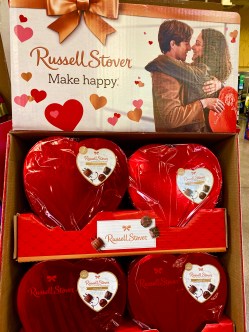 The pharmacist then shifted his focus from medicinal lozenges to candy, founding what would become the New England Confectionery Company or Necco. From this beginning messages on hearts evolved and the new colorful “conversation hearts” became a great success from the 1900s to today, with Necco becoming the leading manufacturer of the hearts. Today some hearts even say “text me.”
 Multiple studies have looked at what attracts couples to each other, causing them to have a romantic or love attachment. Much of the “biology of love” can be explained by chemistry. That romantic attraction or “zing” arises from hormones, stemming from the brain, not from the heart as we often believe. These hormones kick up lust, attraction, and a desire for attachment—that feeling of “falling in love”—which can hit you hard with an assortment of hormones rushing into play.
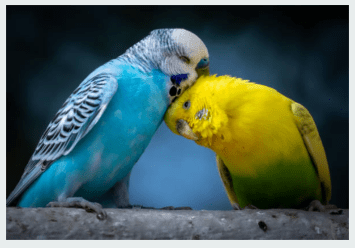 Like the old saying “birds of a feather flock together,” and research has shown that couples are more likely to pair up with others who share similar looks, attitudes, interests, beliefs, and values. People also tend to be most attracted and comfortable with others similar to themselves, somewhat disputing the “opposites attract” theory. The entire psychological subject of how attractions form is fascinating to read about. Basically, though, we all seek to be liked and loved.
 Once a relationship forms, it tends to have certain common elements: aspects of passionate and emotional love, intimacy and liking, the enjoyment for each other’s company, and affectionate companionate love, along with trust, understanding, and caring. An interesting phenomenon occurs as couples spend extensive time together. Atoms interchange between them and the atoms recognize, and are drawn to each other again, when the loved partner comes into proximity. Love is truly a science and a mystery and like the old song ‘a many splendored thing.’


 Many of us hold special memories about Christmas in our homes and the traditions we cherish … but I also hold many special memories of traditions and events held around my hometown of Knoxville, Tennessee. Every fall, my mood begins to swing toward thoughts of Christmas when J.L. and I visit fall festivals and Christmas-themed shows where we begin to see Christmas decorations, handmade ornaments, gift ideas … and run into Santa!!! I usually buy my Christmas cards in the fall and do my holiday shopping then, too, but my real mood swing toward Christmas doesn’t begin until after Thanksgiving is over.
 In the week after the Fantasy of Trees, downtown lights begin to appear around town, the big Christmas tree is lit in Krutch Park, and the annual Santa Claus Parade is held downtown, usually on the first Friday evening in December. Today, many elaborate parades are held all over America and televised, but when I was a girl this parade was looked forward to with great excitement and anticipation every year. Our family always sat to watch the parade on the high wall behind the post office building where my dad worked. It was such a thrill to hear and see the bands coming down the street, to see the decorated floats, and to wave at Santa Claus at the end of the parade. When my brother was in high school, he marched in his high school band in the Christmas parade and later strutted down the street ahead of his band as the school’s drum major. I, too, got my taste of being in the parade, marching in a sequined outfit with Claudette’s majorettes one year.
 The Christmas theme and colors of the lights change every year, as do the holiday shows, always making visiting Dollywood a beloved holiday tradition. The annual event is called “Smoky Mountain Christmas.” The holiday shows, carolers, Christmas parade, and other performances are always a delight and if you stay late in the evening, there are colorful fireworks, too. Dollywood is a joy year-round but at Christmas it is especially beautiful.
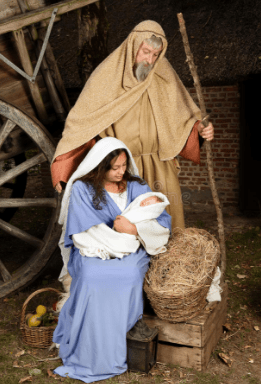 Special favorites of ours have always been the Living Christmas tree choral show performed at several local churches around town and the holiday concerts we can catch at area churches. We especially enjoy Christmas at West Park on Middlebrook and the Christmas Carol Show at the Catholic cathedral on Northshore Drive. Always on our list, too is the Nativity Pageant, a free drama presenting the story of Jesus birth in story and song put on at the Knoxville Coliseum. This beautiful event is now in its 53rd year and brings the Christmas story to life with glorious music, realistically portrayed Biblical characters, even donkeys and sheep, and closing with all standing to sing the Hallelujah Chorus at the end.
 Another favorite part of the holidays is visiting the West Town Mall and its large department stores to see the beautifully decorated trees and holiday decorations throughout the mall. In times past, the mall used to be much more lavishly decorated than today but it is still fun to wander through the large indoor mall and stores to see all the lights and tree decorations. Often the florists around town decorate for visitors, too, and there used to be several we especially loved to visit. When I was a girl, the downtown Rich’s department store extravagantly decorated inside and outside, and inside its tunnel leading under the street to the parking garage. The store also held a free choral concert outside which my family always attended, too.

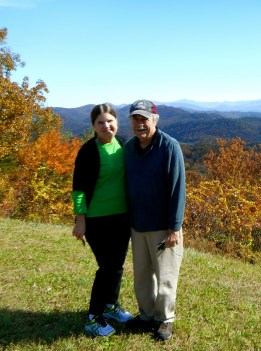 The Foothills Parkway in East Tennessee is a beautiful two-lane scenic highway skirting near the borders of the Great Smoky Mountains National Park. The legislation for the Foothills Parkway, Public Law 232, was approved and passed by Congress on February 22nd in 1944. The entire 72-mile road was originally intended to stretch from Exit #443 off Interstate 40, near Cosby and Newport, TN, to US Highway 129 near Tallassee and Maryville, TN far to the west. Originally, plans for the Parkway were laid out in eight distinct sections but construction didn’t begin until the 1960s and, to date, the full parkway is still not complete. Of all the seven different U.S. Congressionally Mandated Parkways, the Foothills Parkway is the only one yet to be finished.
 Due to funding difficulties in the 1970s, erosion and environmental difficulties, the continuing sectional pieces from Walland to Carr Creek (6.1 mi) and Carr Creek on to Wears Valley (9.7 mi) weren’t totally completed and opened until 2018, fifty-two years later. In between these years, the east end of the parkway (Section A) from Interstate 40 to Cosby, a 5.6-mile stretch of roadway, was completed in 1968, but the proposed parkway sections from Cosby to Pittman Center (14.1 mi) and on to U.S. 441 (9.6 mi) have never been started nor has the additional 9.8 mile section of the parkway to Wears Valley.
 In actuality the Parkway has been in the works, since its legislation date, for over 75 years, and it will probably be another 20 years or more before all the missing sections are completed. The right-of-way for constructing the remaining sections has been purchased by the National Park Service, which is a plus, but funding is not in place for the work to be done at this time. According to the National Park Service, the next section proposed for completion is section 8D between Wears Valley on US Highway 321 and the Spur on US 441/321 near Pigeon Forge and Gatlinburg. Since the completion of the new stretch of parkway, traffic on Wears Cove Road and Line Springs Road to Metcalf Bottoms is now exceeding design capacity and safety concerns have pushed completion of this parkway section to the forefront.
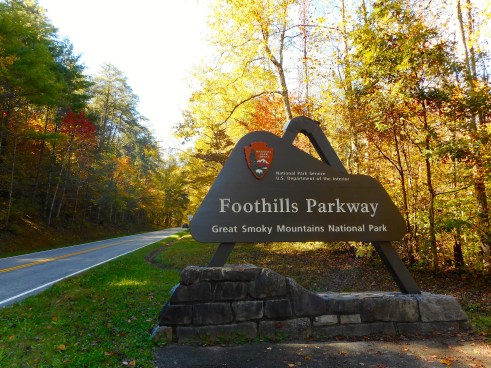 Parkway background and history aside, traveling the completed sections of the Foothills Parkway is a pleasure at any time of the year, but it is especially beautiful in the fall. Many travelers to the Smoky Mountains know little about the Parkway but locals love it as a place to travel to enjoy views of the mountains, generally without the crowds and traffic found within the National Park. Many websites call the Parkway “The Unfinished Dream” and sing of its beauty even as it is.
 This week we traveled across all three sections of the Foothills Parkway to see the fall colors beginning their annual show in East Tennessee. Our journey started on the west end of the Parkway where the road begins at Highway 129. Across the street from the entrance is Chilhowee Lake, created in 1957 when the Chilhowee Dam was built. Nearby on the highway are pull over spots to see the lake more clearly or to put in a boat or fish. About a block south of the entrance Happy Valley Road winds between Chilhowee Mountain and the Smoky Mountains to Abrams Creek Campground in the Smokies. A narrow road leads to a ranger station, parking spaces, and the small campground and to several fine hiking trails. J.L. and I love to hike here and especially love the Cooper Road Trail which winds out of the back of the campground toward Cades Cove.
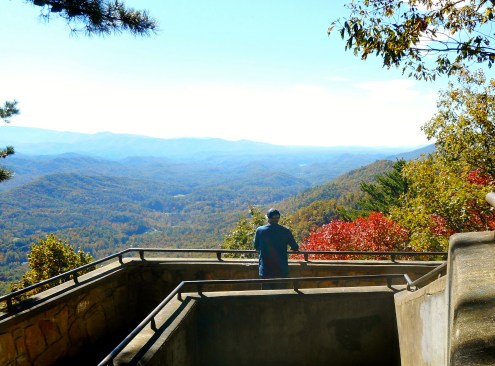 Across the street from the parking lot, you can also hike the paved one-half-mile trail to Look Rock Tower. The path is steep but there are several rest stops along the way. At the tower, you can walk up the ramp to the railed observatory area, which offers a 360-degree panoramic view of the mountains. Signs around the deck tell you the names of the mountains and ranges you can see in the distance … and the tower, with visibility 20-miles or more on a clear day, is a great spot for photos.
 At the end of this 18-mile stretch of parkway, you can exit onto Hwy 321 for fuel, food, or a rest stop, or continue into the newly completed 16-mile section of the Foothills Parkway ending in Wears Valley. We continued on, following the Parkway as it rose from the gap at Walland to wind up hill along Raven Cliff Ridge and Bates Mountain to the high Chilhowee Mountain range again. We stopped often to take photos and enjoy the fall colors along the way. As this section of the Parkway rises high on the mountain, pull-overs offer stunning views toward the Smoky Mountain ranges. Where the ridgetop crests a wide pull-over yields especially fine vistas.
  At these high points you will also catch views of the bridges spanning the mountain ridge tops, which were an ongoing challenge to build on this Parkway and held up completion of the road many times. As the two-lane road winds downhill scenes of Wears Valley and the ridges and around it appear until the Parkway finally ends on Hwy 321 in Wears Valley. Turning right at the Parkway’s end, the highway winds its way back for 15 miles to Townsend or the road leads east for 10 miles to Pigeon Forge.
 From the Foothills Parkway sections, completed on the west end, to the finished section of the Parkway on the east end near Cosby and Newport is about a 45 minute to one hour’s drive, depending on the route chosen and the tourist traffic. We drove and explored the eastern piece on a separate day, traveling from Knoxville (where we live) on Interstate-40 to get off onto the Parkway at Exit #443.
 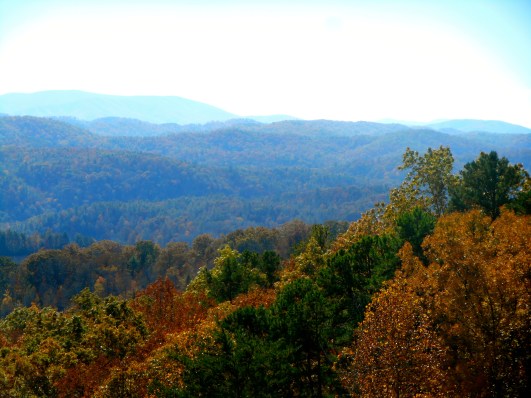 This piece of the parkway, although short, also has several lovely pullovers with views to the Smoky Mountains. At one pullover you can see north to English Mountain and at another south to Mt Cammerer, Mt Guoyot and Mt. LeConte. The mountain town of Cosby, the Cosby Campground, picnic area, and a number of fine hiking trails are not far from the west end of the Parkway, and visiting around the area makes the trip more fun. We often take a hike after driving the parkway and make a side visit to Carver’s Orchard on the Cosby Highway, for fresh apples in the fall.
 Lin Stepp