“To know your future, you must know your past.” – George Santayana
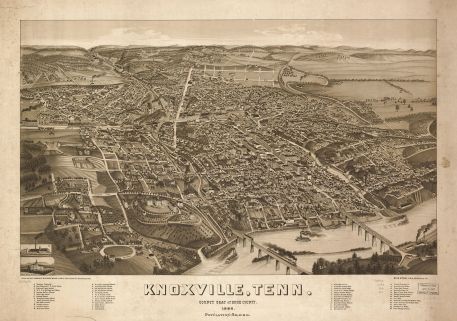 With the weather a little cooler around the East Tennessee area, J.L. and I decided to take a day and visit seven of the best-known historic homes in our hometown of Knoxville, Tennessee. Most of the sites we had visited in times past but others we hadn’t explored at all, so we had a fun day traveling around Knoxville, visiting all seven sites in the chronological order in which they’d been built. I hope you’ll enjoy sharing in our journey, with a photo of each site and a few brief notes about it, and I hope this post will make you eager to look into historic sites you can visit in your own hometown and community. I think you will find it more interesting than you might imagine, helping you learn more about your city’s past—and your own past. As David McCullough once wrote: “History is who we are and why we are the way we are.”
 The city of Knoxville began in the 1700s on a point high above the Tennessee River, on wilderness land once a part of the hunting grounds of the Cherokee Indians. What we know today as “downtown Knoxville” started with the first pioneer home built by James White in 1786 on Hill Avenue. White is called the Founder of Knoxville and he came from North Carolina to settle on a 1000-acre land grant given to him for his service as a Captain in the Revolutionary War. He soon built a fort around his home and gradually other outbuildings were added, a smokehouse and well, weaving house, blacksmith, and guest house, soon making it a hub for travelers and for trading. James White negotiated several treaties with white settlers and with the Cherokee. In 1791, working with President Washington’s Secretary of War, Henry Knox, White and his son-in-law Charles McClung divided a part of his downtown land into lots to help develop a town, which they called Knoxville after Henry Knox. In 1790, White’s fort was restored and opened to the public, and today visitors can take a tour of the grounds and learn about life in these early days in Knoxville.
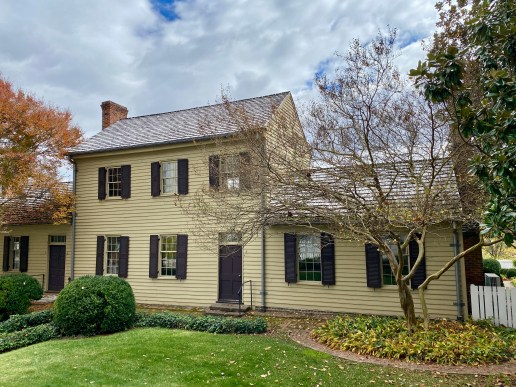 Across the street from the James White Fort is Blount Mansion, built by William Blount in 1792. William Blount, a signer of the United States Constitution, chose Knoxville as the area’s first territorial capital. He built his home for his wife Mary Grainger Blount and their children, and their fine home was also used for business and state meetings. Few pioneers, and especially the Indians of that era, had ever seen a home like the Blounts’ with glass windows and refined furnishings. Blount played a leading role in helping Tennessee to become a state and he became one of Tennessee’s first United States Senators in 1796. I wrote about Blount Mansion in an earlier post in November of 2022 if you want to read more about this site and see more photos.
 Our next visit was to Marble Springs State Historic Site, the last home of John Sevier. The 350-acre farmstead on John Sevier Highway contains the cabin homestead of John Sevier and his second wife Catherine. Sevier was a Revolutionary War soldier, a frontier militia commander, a hero of King’s Mountain, and later the first governor of Tennessee, serving six terms as governor in total. He lived at Marble Springs from 1790 to 1815. Visitors can take a “self-guided tour” around the grounds to see the Sevier cabin, with an added kitchen, nearby herb garden, smokehouse and spring house. On the grounds are other outbuildings made into an office and gift shop, plus an old tavern, moved to the site from West Knoxville. Many events and reenactments are held at Marble Springs and several hiking trails can be enjoyed on the property.
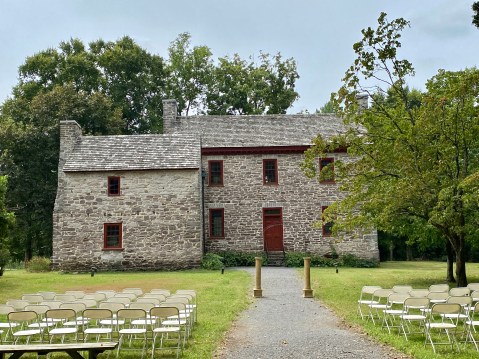 After leaving Marble Springs we drove to east Knoxville, crossing the Holston River, to historic Ramsey House on Thorngrove Pike, built in 1797. I’ve toured this house several times and have been to events here as an author. It’s a lovely old home to tour, on the National Register of Historic Places, and has been beautifully preserved. The stone house was constructed with marble and limestone and often called the “finest house in Tennessee” because of its architecture. The house was built by Colonel Francis Ramsey (1764-1820) and his wife Peggy, and the Ramseys were among the earliest families to settle in the Knoxville area. Colonel Ramsey was a leader in the military, a surveyor, a plantation owner, and a statesman. With John Sevier, James White, and William Blount, Ramsey was involved in the establishment of Knoxville and played many roles in the city’s early history.
 Crossing the Holston River again, we next visited the Mabry-Hazen House on Dandridge Avenue. Also listed on the Register of Historic Places, the house, built in 1858, is located atop Mabry’s Hill on an eight-acre site. The two-story Italianate house was constructed for Joseph Alexander Mabry II. Mabry was a wealthy Knoxville merchant and importer who helped the Confederate army during the war, with forces once occupying his home. His daughter, Alice, and son-in-law, Rush Strong Hazen, inherited the house which later passed to their daughter Evelyn. After Evelyn’s death the house opened as a museum. The day we visited, a group of homeschoolers had just taken a tour of the house, learning more about Knoxville’s early history and how people lived in past times.
 Knoxville developed first in areas close to its downtown. Many old homes like the Mabry-Hazen house and Ramsey House can be found in the East Knoxville area, where the Chilhowee Park was also created in the late 1800s. Other prominent homes developed to the North in Old North Knoxville in the last half of the 1800s, as did other fine homes heading West of downtown beyond the new University of Tennessee on Kingston Pike. The Pike was only 30 feet wide when first created in the 1790s, created to connect downtown Knoxville to Campbell’s Station further west. Crescent Bend is thought to be the oldest residential structure on Kingston Pike, built by Drury Paine Armstrong (1799-1856) and his family in 1834, on what was then a large tract of 600 acres of land. The big two-storied white house has lavish interiors and a commanding view of a bend in the Tennessee River behind it. Today the grand house can be toured but it is best known as an event site for lovely weddings and gatherings. The home has a beautiful tiered garden on its grounds, with nine terraces, five fountains, and lovely statuary, and in the spring the grounds are lush with flowers and masses of tulips.
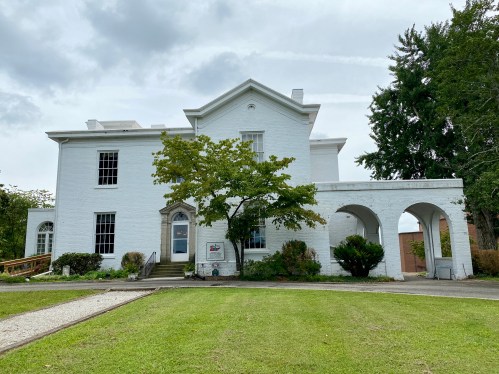 The next historic home on our list, Bleak House, was built by Drury Amstrong’s son Robert Armstrong and his wife Louisa in 1858 on a part of the family’s land they were given. Beautiful portraits of the couple hang inside the house in the front parlor. An antebellum Classical Revival style home, it also is on the National Register of Historic Places. The house was used as a Confederate headquarters during the Battle of Knoxville and two cannonballs are still imbedded in the walls. The home, now called Confederate Memorial Hall, belongs to Chapter 89 of the United Daughters of the Confederacy. It is rich with Civil War history. Tours can be arranged, and like Crescent Bend, many weddings and events are held at this elegant white house on the hillside. It, too, has lovely grounds and gardens.
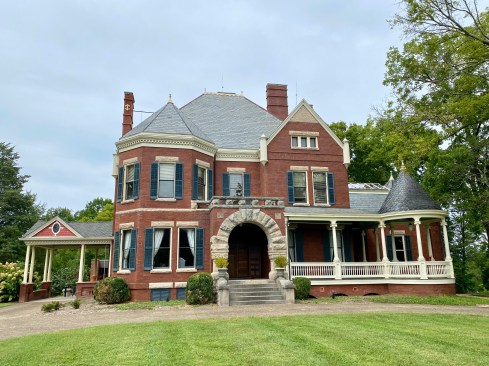 The final visit on our historic house tour was to Westwood, also on Kingston Pike, built in 1890. This Queen Anne brick home with its ornate exterior touches and Romanesque stone elements was built for John Lutz and his wife Adelia Armstrong Lutz. This is another home linked to the Armstrong family, the land given to the couple by Adelia’s father Robert Armstrong of Bleak House. Westwood house once sat on a large estate property with extensive grounds. The house stayed in the Lutz family until 2009 and was later given to Knox Heritage to restore in 2013. The interior of the home is beautiful and one of its special distinctions is that there is still a painting studio and art gallery in the house, with over 30 of Adelia Armstrong Lutz’s paintings. The studio is stunning to see with red walls and gorgeous architecture. Adelia was a prominent and well-known artist of the day and is considered to be the first professional woman artist in Knoxville. Her home, Westwood, was inducted into the prestigious Historic Artists’ Homes and Studios (HAHS) network in 2002.
 Knoxville is my home town, surrounded by beautiful natural scenery, and I do love it. Knoxville had the first state newspaper in Tennessee and it is the home of one of American’s oldest state universities, The University of Tennessee, started as Blount College in 1794. Knoxville was the first capital of the state of Tennessee, and Knoxvillians have run for president, won Pulitzer prizes, served in famous military roles, been recognized as conservationists, scholars, and industrial leaders. I’m sure your home town is full of rich history, too, and I hope you’ll take some time to visit some of the historic sites and buildings where you live. Robert Penn Warren said: “History cannot give us a program for the future, but it can give us a fuller understanding of ourselves and of our common humanity, so that we can better face the future.”
See you next month and note: I am not a history scholar and thus might have gotten a fact or two wrong in my account. … Lin
Note: All photos my own, from royalty free sites, or used only as a part of my author repurposed storyboards shown only for educational and illustrative purposes, acc to the Fair Use Copyright law, Section 107 of the Copyright Act.
 Lin Stepp
Thanks for your interesting comments and facts about Knoxville’s historical homes.
LikeLike
Glad you enjoyed it. Thank you!
LikeLike