 READ MORE IN 2024
“To read is to fly.” – A. C. Grayling
Here at the new year, many people are crafting their New Year’s Resolutions. “Read More” is a popular resolution and for good reason! It’s no secret that reading is good for you. Here are some reasons by an assortment of experts, philosophers, educators, and authors about the benefits of reading to make the resolution to “Read More in 2024 ” get on your New Year’s list.
“The more you read, the more things you will know. The more that you learn, the more places you’ll go.” [Dr. Seuss, bestselling author]
“One of the most obvious benefits of regular reading is learning. In a world where our attention spans are declining … books go much more in-depth about a particular subject.” [ Leon Macfayden, author and psychologist]
“All I have learned, I have learned from books.” [Abraham Lincoln]
“Reading transports us to worlds we would never see, introduces us to people we would never meet, and instills emotions we might never otherwise feel. It also provides an array of health benefits. Not only does regular reading help make you smarter, but it can also actually increase your brainpower. Just like going for a jog exercises your cardiovascular system, reading regularly improves memory function by giving your brain a good workout.” [Abigail Fagan, PhD]
“If you are going to get anywhere in life, you have to read a lot of books.” –[Roald Dahl, bestselling author]
“The average person reads 1.5 books per year while the average top CEO reads over 50 books per year. They don’t do this to brag on social media … They do this so they can maintain a competitive edge. To keep their minds sharp. To stay on top of their field, find new ideas that can improve their lifestyles and their business….Reading is the most common activity performed by some of the most successful people of our time. “ –[Ivaylo Durmonski , Life Advice article]
“The world belongs to those who read.” [Rick Holland]
 “Reading is to the mind what exercise is to the body.” [ Joseph Addison, 17th Century English writer]
“With the modern barrage of media and instant technological information, our attention spans are getting shorter and shorter. Reading a book, unlike skimming a web page, forces you to focus. To get the most out of a story, you must fixate on the plot and complete the book. In doing this, your brain forms deep connections and practices concentration….Your brain goes beyond the words on the page, imagining details such as appearances, emotions, and surroundings.” – -[Ariel Abke, Pearson]
“If most of your daily reading consists of social media posts, text messages, and news headlines, you’re missing out….Reading stimulates a complex network of circuits and signals in the brain and provides access to in-depth knowledge…Being able to concentrate and focus for long periods is essential to our success and wellbeing … Our brains have a ‘use it or use it’ policy, just like our muscles. In other words, if we don’t exercise our minds regularly, our cognitive abilities may decline.” – [Thomas J. Law, Oberlo article]
“A growing body of research indicates that reading literally changes your mind and brain…People who’ve engaged in mentally stimulating activities all their lives were less likely to develop the plaques, lesions, and tau-protein tangles found in the brains of people with dementia and alzheimer’s….What should you be reading? The short answer is: Whatever you can get your hands on.” [Erica Roth, Healthline article]
“Reading is essential for those who seek to rise above the ordinary.” [Jim Rohn]
“You are everything that you consume … And if you choose poorly, you will think poorly.… Television is a medium that inspires a kind of mindless passivity in the viewer, making them particularly suggestible to whatever information or entertainment they were being exposed to, and therefore, easily herded into accepting predominant views … Unlike reading a book, watching television takes an unbelievably little amount of effort. There’s a reason television is widely recognized as the lazy man’s preferred mode of entertainment. … The content is not designed to delight and inform as much as it is to keep you placidly watching. It’s no wonder that the research on outcomes of television consumption tend to be abysmal. People who watch craploads of TV are generally unhappier, unheathier, more paranoid about the world … and are more likely to have behavioral and social problems.” [Mark Manson, New York Times bestselling author]
 “Reading makes the mind grow.” – [Kacey Riel]
“Reading creates new memories. With each of these new memories, your brain forms new connections between neurons called synapses and strengthens existing ones. As you read you are memorizing and recalling words, ideas, names, relationships, and plots. You’re essentially training your brain to retain new information. Reading makes you smarter, it’s that simple.” –[Joe Rogan, JRE Library]
“Not all readers are leaders, but all leaders are readers.” [President Harry Truman]
“Reading is the best way to relax and even six minutes can be enough to reduce stress levels by more than two thirds, according to new research. …It really doesn’t matter what book your read, by losing yourself in a thoroughly engrossing book you can escape from the worries and stresses of the everyday world and spend a while exploring the domain of the author’s imagination.” [David Lewis, The Telegraph]
“Reading also comes with health perks: Research suggests that devouring books helps keep the mind shaper for longer, while lowering heart rate and feelings of psychological distress. Plus reading before bed can improve sleep quality.” – [Angela Hunt, Time Magazine]
“Research suggests that reading literary fiction helps people develop empathy and critical-thinking skills. Becoming immersed in a book allows us to enter the perspective of characters—not just their thinking but their feelings …Reading is one of the best inventions that humans gave to humanity and yet people completely take it for granted.” – [Maryanne Wolf, author]
 “Reading helps us gain insight into our own lives and the lives of others.” [Diana Raab, PhD, Psychology Today]
“Reading fiction can help us gain phenomenal, empathic, modal, and moral knowledge which helps us in our practical life.” [Zanab Arif, Benefits of Reading Novels]
“As you identify with another person, a protagonist in the story, you enter into a piece of life that you wouldn’t otherwise have known. You have emotions or circumstances that you wouldn’t have otherwise understood.” –[Keith Otley, University psychologist]
“The reading of all good books is like conversation with the finest people of the past centuries.” [Descartes]
“Reading is an exercise in walking in someone else’s shoes for a while.” [Madeleine Blackman]
“Reading a variety of topics can make you a more knowledgeable person, in turn improving your conversation skills… By reading books about protagonists who have overcome challenges, we are oftentimes encouraged to do the same. The right book can motivate you to never give up and stay positive, regardless of whether it’s a romance novel or a self-help book.” -[MPL Karen, Markham Public Library]
“Reading is one of the best ways to foster imagination…. Reading is a key part of enhancing imaginative thinking which can lead to innovation and understanding.” [Alexandra Akinchina, World Literacy Foundation]
 “The seeds of dreams are often found in books.” [Dolly Parton]
“Reading is a form of training for living. Books teach us how to think, how to relate to people, what to do, who we are and who we should be. For the most part, they teach us how to live … We all need guidance and books have a unique knack for providing it. Books enable us to garner more experience and knowledge than it would be possible to accumulate in a lifetime. We can learn from the mistakes and successes of others, applying their wisdom to our lives.” [Rosie Leizrowice, Huffpost article]
“To acquire the habit of reading is to construct for yourself a refuge from almost all the miseries of life.” –[W. Somerset Maugham, author]
“Books are a uniquely portable magic.” [Steven King]
“To me there are few things as pleasurable in life as reading a new book and loving it …A good author can make a reader feel like they’re talking to an old friend….Good stories have themes that can be applied to an array of real life situations that teach us valuable lessons on morality and what it means to be a good person…reading may be the best way to grow as a human.” [ Peter Lord, author]
“Once you have read a book you care about, some part of it is always with you.” [Louis L’Amour]
 “When I think of all the books still left for me to read, I am certain off further happiness.” [Jules Renard]
“Life is defined by the decisions we make and I’ve come to view life as a series of adjustments. As we increase in age and wisdom, we begin to recognize opportunities in our life to grow and improve. Any decision to embrace that opportunity could best be labeled as a resolution. I’ve just never understood why we’d wait until January 1st to make the change. … Every time I read a new book, I am stretched as a person … That’s why I’ve taken this occasion of a new year to purposely resolve to read more books.” –[Joshua Becker. Becoming Minimalist e/1 M readers a month]
I hope you will decide to make “Reading More Books” one of your New Year’s Resolutions, too. … Have a wonderful New Year! ... Lin
Note: All photos my own, from royalty free sites, or used only as a part of my author repurposed storyboards shown only for educational and illustrative purposes, acc to the Fair Use Copyright law, Section 107 of the Copyright Act.
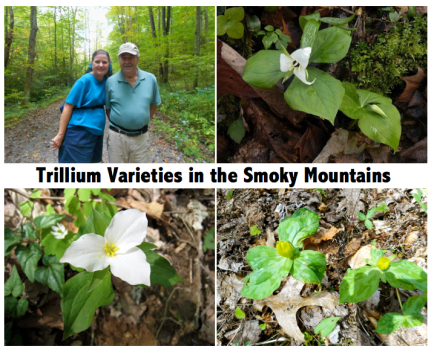 Living near the Great Smoky Mountains, I look forward to the wildflowers blooming every year. When J.L. and I were working on our hiking guidebook, we were on the trails often through all seasons, always seeing new flowers along the way. But April was always the prettiest month of the year for enjoying the wildflowers. It’s also in April when the wildflower pilgrimages and wildflower walks around the mountain areas are held. There are more than 1,500 kinds of flowering plants in the Smokies, more than in any other national park, so there are always many varieties and types of wildflowers to discover.
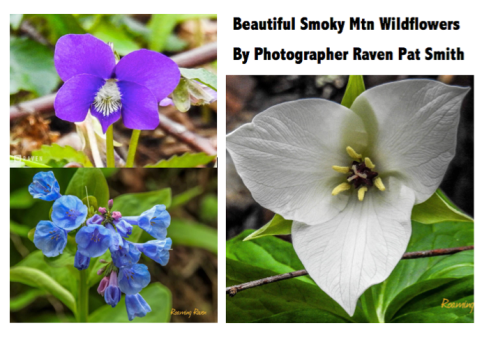 On our hikes and walks in the mountains, we have taken many photos of wildflowers, like the photo of us at the beginning of this post with several varieties of trillium, an early Smokies wildflower. However photographer fans and friends of ours, that we’ve met on the “writer’s road,” take far more spectacular and beautiful photos than we do, so I’ve spotlighted some of their work in this blog post. Raven Pat Smith’s photos above show a glorious white trillium, an early purple violet and wild bluebells.
 We often discover daffodils, flowering shrubs, and non-native plants around the crumbling walls, foundations, and chimneys of old homesteads—the flowers living on long after the people and farms are gone. Marie Burchett Merritt’s photos on the right show dogwoods in bloom, yellow trillium, and wild dwarf iris—that I always love spotting on the trail.

 Vibrant pink Catawba rhododendron, like in Kristina Plaas’s photo, grow in the higher elevations like on Andrews Bald or near the Chimney Tops Trailhead. Many wildflowers we simply run into along a trail … stopping to delight in our “finds.” Special wildflowers, always a treat to discover, are white dutchman’s britches, yellow lady’s slippers, and red Indian paintbrush, also in Kristina Plaas’s photo above.
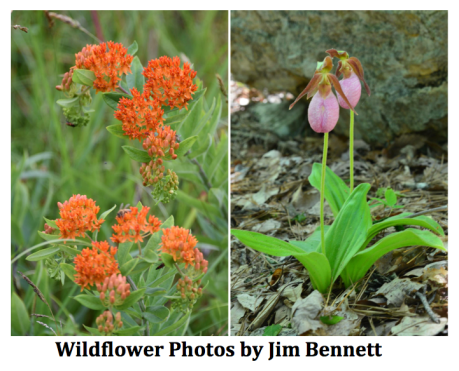 We tried to mention in our hiking guide The Afternoon Hiker trails especially known for wildflowers but flowers in the mountains often show up in unexpected places, and there are flowers of different types to see from early spring into the late fall. But April is still the best time to see the most wildflower varieties in the mountains. If you ever come to the Smokies in April the show of wildflowers will delight you and give you lovely memories to carry home. But remember that anytime you explore the woods, parks, and fields near your own hometown in the warmer seasons that you will find wildflowers, too. This month, I hope you will head outdoors—and get out of your car and walk up a trail—to enjoy the beauty you will find at every turn.
 I have a new Mountain Home Book coming out March 16th titled SHOP ON THE CORNER. I enjoy writing all my books, set around the mountains and at the coast … but this book was especially fun for me to write. I got really attached to all the characters in the story and had so much fun creating their adventures. I also loved revisiting, on several trips, the Waynesville, North Carolina, area to work on this book, walking the downtown streets, stopping in all the charming stores, eating in the cute local restaurants. Each visit reminded me again how much I like this picturesque and engaging North Carolina town.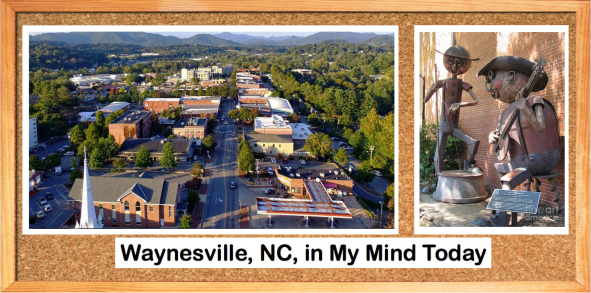
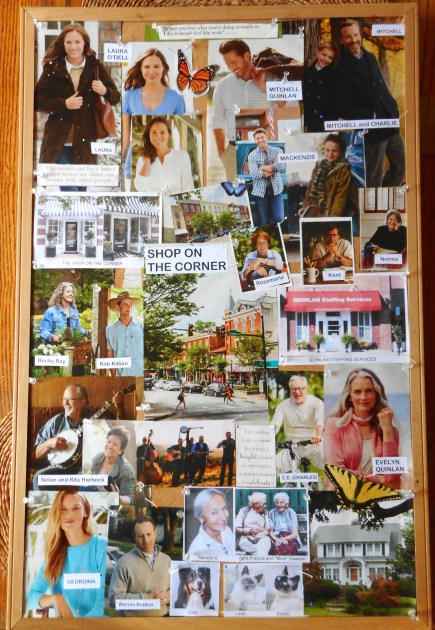
 As you may guess, that change takes her to Waynesville, North Carolina, to an empty shop for sale right on a corner near Waynesville’s main street. It’s a big move for Laura, who has never been to Waynesville before, but she soon finds the change to be a good one. This is due in part to meeting Mitchell Quinlan who owns Quinlan Staffing Services across the street from Laura’s shop. There is definitely a little sizzle of attraction when they first meet. However, both have a host of life problems and responsibilities going on … and they soon get drawn into other problems and issues around the town of Waynesville … as you will, too!
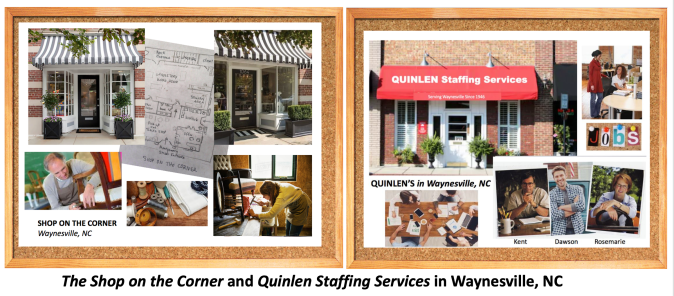 A special pleasure in working on this book was creating two very unique businesses, Laura’s upholstery shop and Mitchell’s family staffing business. I did a lot of research for both businesses to make them as accurate as possible. Years ago, I actually did a short-term temp job in a staffing services office here in Knoxville, TN, and in a past sales job, I often visited with a favorite sales client, Bob Cable, at his upholstery store, Ledford’s Upholstery, in downtown Elizabethton, TN. I so enjoy creating businesses like these. One of the pleasures of being an author to me is “trying” out a host of occupations and careers through my book characters!
 You’ll see the pictures here of how I imagined that my four main story characters might look…. Laura O’Dell and her sister Georgina, Mitchell Quinlan and his mother Evelyn, an area artist and art instructor. Each of these individuals had distinct personalities and you’ll come to know each well in the book, along with a wide host of enjoyable side characters I truly loved spending time with in my mind. These include friends and work associates, Mitchell’s niece and nephew, Mackenzie and Charlie, and Mitchell’s other relatives—especially his grandmothers, Nannie V and Mimi—and all the wonderful Barlow family. You’re in for a treat with this rich southern story, along with the extra addition of a running local mystery to follow.
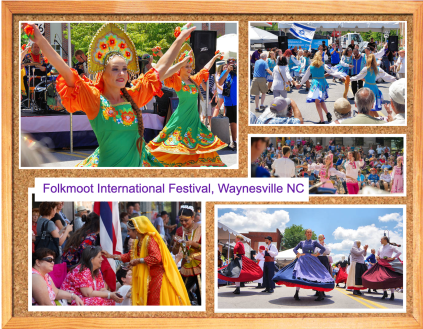 Those of you who read my books know that I set all my stories in “real” places and try to use as many real streets, shops, restaurants, and tourist sites around the area as I can so readers will feel like they have actually visited in the settings of my books. Besides getting to know Waynesville … you’ll also enjoy sitting on Main Street with my main characters to watch the annual Folkmoot International Festival Parade wind its colorful way down the street. I’ve been in Waynesville to enjoy this parade in July … and it is stunning to see.
 A short distance from Waynesville, too, is the beautiful Lake Junaluska Conference and Retreat Center, a lovely place set around a picturesque lake with a walking trail all around it. You’ll get to take a nice walk on that trail with Mitchell, Laura, the kids, and the family dog Zoey at one point. I’ve stayed at Junaluska in past and also signed books at the retreat center’s bookstore. Junaluska is especially beautiful when the 200 roses bloom on the lakeside Rose Walk.
 Waynesville is also near many well-known tourist attractions. One is the Biltmore House, Gardens, and Estate. Biltmore is the historic home and property built by George Vanderbilt, still owned by his descendants and covering over 8,000 acres. It is a major tourist attraction and draws over a million visitors a year to tour the historic home and the beautifully landscaped grounds and gardens. At one point in the book, you’ll get to visit Biltmore with Mitchell and Laura … and learn more about it.
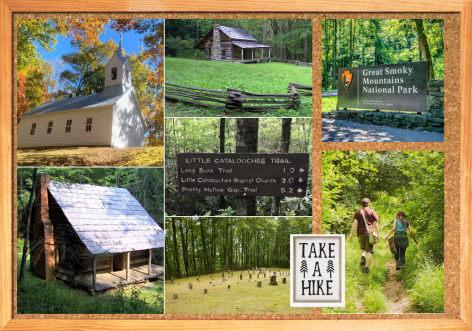 Additionally, you’ll get to take a hike in the Cataloochee area of the Smoky Mountains with Mitchell and Laura. … A fan once told me that one of her favorite things about my books was that I always put a hike in every book. I went back to check and it’s basically true. I like to show readers what a pleasure a “walk” or hike in the mountains can be. In this book you’ll get to hike and learn more about the Little Cataloochee Trail and the Cataloochee Valley, once the home of many settlers. Cataloochee is as beautiful as Cades Cove—but less crowded.
 Through books, readers get the joy of living many lives and visiting a multitude of new places. I hope you’ll enjoy meeting the rich array of characters I’ve created for SHOP ON THE CORNER and that you’ll love visiting this colorful small town. As the back of the book reads: “Sometimes life’s unexpected hardships force you to consider drastic changes you’d never have dreamed of but lead in time to some sweet and unexpected joys.”
 On March 16th I have a new book coming out in the Lighthouse Sisters series. This third title in the series is called LIGHT IN THE DARK. It follows Celeste’s story, who grew up at her family’s inn by the Deveaux Lighthouse on the South Carolina coast. As the back of the book reads in brief: “In this third novel in the beloved Lighthouse Sisters series, Celeste Deveaux struggles to find her way back to joy, love, and meaning after a painful relationship almost shatters her life.” I hope you’ll enjoy Celeste’s journey in this new novel with a little romance, a touch of suspense, and rich scenes on the coast at Edisto and in downtown Charleston.
 For me, most all of my book story ideas come from thoughts or mental pictures that slip into my mind while visiting the places I write about. My home and heart live here in the mountains of Tennessee, but our favorite vacation spot is Edisto Beach, that we first visited when our children were small in the 1980s. Edisto is a quieter and less commercially developed place than busier beaches like Myrtle Beach or Hilton Head nearby. We loved this aspect of the island, enjoying the easy beach access, the peace and calm of this laid-back coastal community.
 One summer at the end of the 1990s, when J.L. and I were vacationing at Edisto, we visited Hunting Island State Park and the big lighthouse there. The idea began to play around in my mind, wondering what it might have been like for four sisters to grow up on a windswept island beside a lighthouse. I soon began to envision these sisters, each different and distinct, raised in the family’s big bed-and-breakfast for tourists that had once been the lighthouse keeper’s home. Ideas began to drift in more and more and I was soon excited about this new book idea.
 Once I get an overall concept and loose plan for a book, I begin to visualize the main characters for the books. For this four-book series, each book focuses on one of the four sisters. The first book LIGHT THE WAY introduced fictitious Watch Island on Edisto’s north end, plus the Deveaux Inn, Lighthouse, and the Deveaux family. The head of the family, Lloyd Deveaux has died unexpectedly, bringing sorrow and more work load to his wife Etta and to her daughter Burke. The oldest sister, Burke, has always loved the life at the island and never left as her sisters have. LIGHT THE WAY Is Burke’s story … and it becomes Waylon Jenkins’ story, too, when he retires from the Navy to come back to his family home on Edisto. Waylon and Burke grew up together, and it is sweet how they reconnect in this story. Lila, the youngest sister, has recently returned home, too, and before the book ends, the other two sisters also return, each running from personal problems. Gwen returns home with her three children, hurt over a betrayal with her husband. Not long after that, Burke and Gwen go to Nashville to bring home Celeste, and it is Celeste’s story you will read in LIGHT IN THE DARK.
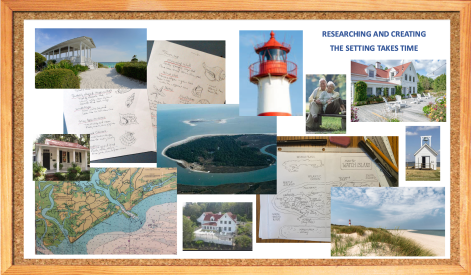 Even though I have always visited the places where I set my books, I return to those settings again to explore as I begin to work on a new book set there. I pick up brochures, take photos, talk to people, learn historic facts, and gather story ideas. As I am researching and creating the settings for a book, I also develop and flesh out all the secondary and side characters. The sisters’ parents, Lloyd and Etta Deveaux, had to come to life, as did a diversity of neighbors and friends. Additionally, I spent months developing the Deveaux Inn, lighthouse, gift shop, and the entire 500-acre lighthouse station. I had to find out how a lighthouse works and to design the interior and operations of the inn and lighthouse. I also spent time learning about and creating the cottages, outbuildings, harbors, marina, and creeks around the island, and developing the employees who would help the Deveaux family run the inn. I studied extensively, too, to gain more knowledge about the South Carolina coast, the tides, ocean, climate, about the island, the lighthouse’s history, Edisto’s marshes, creeks, birds and animals, seashells, and a million other small things that might play into the stories.
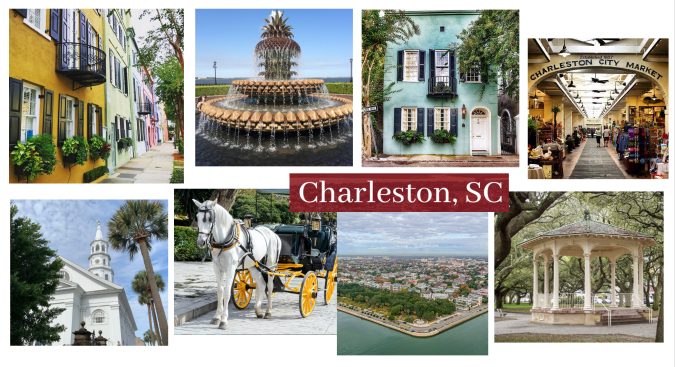 To make each story more unique, I varied the setting focus of each book. LIGHT THE WAY focuses its story and setting on the lighthouse island at Edisto. LIGHTEN MY HEART branches out to take readers to scenes around Beaufort and Port Royal. This third book, LIGHT IN THE DARK, centers much of its story in downtown Charleston. I researched and learned about the city’s history, studied maps and articles, and my husband J.L. and I explored all over the downtown streets where scenes in the book would take place. We discovered so many spots we’d never visited before on these explorations, finding quiet gardens tucked away between gracious historic buildings, sleepy cemeteries, little museums, and cute restaurants and shops. I spent extensive time around King Street where many scenes in my story take place, bringing me wonderful ideas to help enrich Celeste’s story.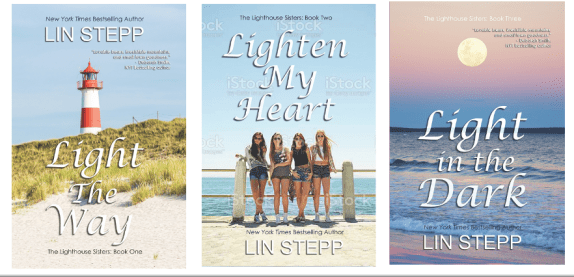
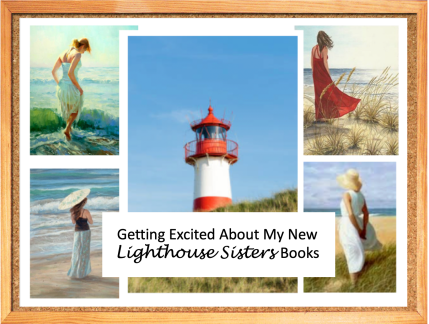
 As an author, I always create an “Inspiration Collage Board” for my books … and here you can see my board for the Lighthouse Sisters books. The four books have a rich array of characters you will meet along the way. All their lives have problems and challenges… and they often little mysteries to unravel. In LIGHT THE WAY, a series of murders are going on around the coastal area that Burke and Waylon get swept into. In LIGHTEN MY HEART Alex’s family’s restaurant gets troubled, as do other Beaufort businesses, by a counterfeiter. And in LIGHT THE WAY, Celeste and Reid work their way through their own set of problems you will soon read about and get caught up in.
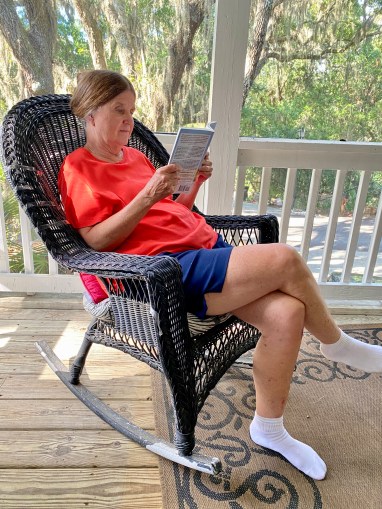 I hope you’ll curl up in a comfy chair in your house, or out on the porch in a favorite rocker, and settle in to enjoy this new Lighthouse Sisters book.


 Up close, some tree leaves are “Smooth Edged” or entire, around their sides, while others are zig-zagged or “Tooth Edged.” Dogwood trees and Crabapple trees, familiar to most, are good examples of “smooth-edged” trees, although the Crabapples do have tiny teeth around their edges. Beech trees are a more obvious example of “tooth-edged” trees. There are several different types of Beech trees but the American Beech is particularly stately and beautiful, often growing into a tall, giant of a tree. Elm trees, too, are “tooth-edged” trees and the well-known American Elm is often a large shade tree with wide spreading branches. The elms and beech in our neighborhood turn a golden yellow and then brown.
 After you begin to study more about tree leaves, you will find that many are recognizable in the fall not only by their color but by their shape. Also, some trees have different shaped leaves on different varieties, like on Sassafras trees. In our neighborhood is a giant red-leafed Sassafras with long simple leaves with no lobes. It turns crimson red in the fall. Also in the neighborhood is a Sassafras tree with three-lobed simple leaves. This shorter sycamore tree’s leaves turn a rich yellow in the fall. I often think these sycamore leaves look sort of like mittens in shape and often the leaves only have two lobes instead of three, looking even more like a mitten.
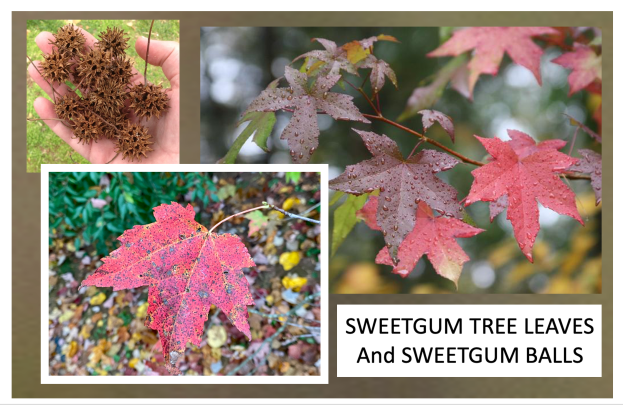
 Often you can recognize trees not only by their leaves but by their nuts, seeds, or berries. The Sweetgum tree is one of those. Its pointed lobed and toothed leaves are somewhat star-shaped. Sweetgum leaves turn red and purplish-red in fall and you can often find the tree’s round, spiny “sweet gum balls” nearby, the tree’s fruit, containing the seed. Young Sweetgum trees don’t produce Sweetgum balls at first but the trees start producing them later as they age.
 The Chestnut tree not only has distinctive leaves, easy to identify, but it produces sticky “Chestnut Burrs” in fall. The leaves on a Chestnut tree are often big, too, like magnolia leaves. My neighbor has a big Chestnut tree in her back yard and it’s her hand you see in the photo holding one of the tree’s burrs.


 Two less common trees to watch for in the fall landscape are the yellow Gingko tree, with its green leaves gradually turning a vibrant yellow and the Red Dawn tree, sometimes called the Dawn Redwood tree, a deciduous tree with leaves that look much like an evergreen Christmas tree. The Ginkgo tree, also native to East Asia, is one of the oldest known living tree species in the world. The leaves have a distinctive “fan” shape, making it easily recognizable. I remember several beautiful Gingko trees on the University of Tennessee campus and we are blessed to have a lovely Gingko in our neighborhood, a beauty of yellow color right now. Another very old tree, you might spot because of its unique leaflets, is the Dawn Redwood. My neighbor has one in her yard and as fall wanes it turns a gorgeous orange. This tree is actually now an endangered species and like many redwoods can grow to a great height.
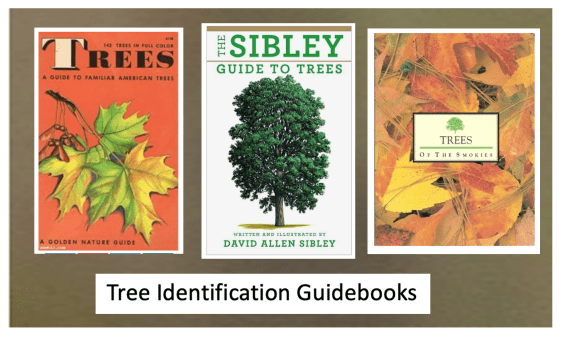
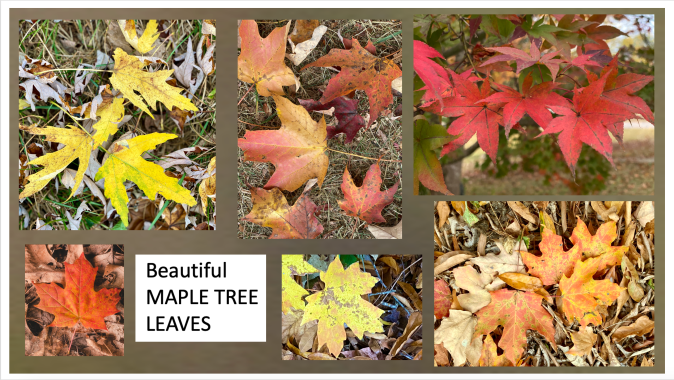
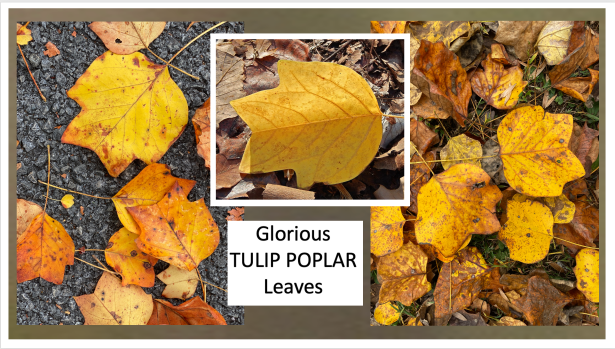
 As you look out across the hillsides at the fall colors, when you’re stopped along the way or driving, many of the yellow trees you see are most likely to be beech, birch, and yellow tulip poplars, while the lush rich orange and yellow-orange trees you spot are probably sugar maples, oaks and sweetgums. The reds scattered and clumped on the hillsides may be mainly maples, dogwoods, sassafras, and oaks. The colors of fall are always a delight and I love knowing that I’ll know more now about what kind of tree I’m seeing as I enjoy them. To learn more about the trees near your home, pick up a “tree guidebook” to help you identify the trees you see, read about identifying trees on the internet, and possibly download one of the “tree identification” apps to help you learn more about the trees in your fall landscape….And enjoy the fall!

