THE TIMES THEY ARE A CHANGIN’ – And So Can You
 Ours is a discouraging world. Our nation is somewhat divided in its beliefs today and many people are divided in beliefs, too, often angry at others with different views. Tolerance and diplomacy seem to be lost arts in our political arena, and kindness and thoughtfulness seem to have flown the coop in our day to day social and work relations in many ways. In America we are seeing more health care problems, educational problems, increased crime, more corruption in business, less loyalty among employers and employees, a rising cost of living without a similar increase in the wages. Shootings, murders, and rampant crime are more often in our news forecasts as well as destructive fires, floods, tornadoes, earthquakes and other natural disasters which used to be rarer in our world. All of these concerns can be discouraging, depressing, and disheartening to read about and see every day.
 My youth and childhood were spent in America’s fifties, sixties, and seventies, and I raised my children in the seventies, eighties, and nineties. The problems in all those years, some worse as my children hit their teen and college years, seem small in comparison to problems we see today. The old Bob Dylan song of the turbulent sixties “The Times They Are A-Changin’” and its words seem truer and more relevant than ever. What can we do now to stay positive, keep from being discouraged, and not disheartened? How can we live effectively in this world situation, finding ways amid all the problems to be our best selves and to help others to live well? How can we make a difference in what seems like such a dark time with so many problems all around us?
 One of the things I feel most saddened about is how the negativism and discord of our times is affecting our children. Kids shouldn’t know the deep, harsh burdens of life too soon, but today’s children are being bombarded with them. Hate, nihilism, and apathy are growing, often leaving children and teens feeling un-empowered and hopeless about their lives and their future. A certain innocence is lost when children know and experience too much harshness and reality at a young age. I guess we shouldn’t be surprised to see depression and suicide rates rising in children, along with obesity, drug abuse, and illnesses we never saw in past societies. Media, in particular, has overly exposed young children to sorrow, too much sexual knowledge, to perversions and horrors they didn’t need to see or learn of yet. Media has also kept them indoors too much, their eyes locked on phones and devices, not happily playing out of doors, laughing, running, jumping rope, riding bikes, and creating happy, imaginative games.
 Many children are being forced to grow up quicker than in past, often forced to stay home alone and take care of siblings while their parents work, and allowed unmonitored access to media, unhealthy eating, and too little outdoor exercise and needed wholesome social interactions. As statistics reveal, our pace of today is taking its toll on our children. I think every generation feels misunderstood, marginalized, and disenfranchised because they are young but this time, we all know, is deeper and darker than times we grew up in. Teens look up their favorite celebrities and idols and see them partying, drinking, vulgar in actions and dress, and are drawn to emulate those idols and mimic their actions. Good role models are often harder to find in media today and children and young people are very impressionable. An immaturity, irresponsibility, and selfishness are being bred in our youth. Statistics show children are showing a lack of motivation, unrealistically pressured by forces all around them.
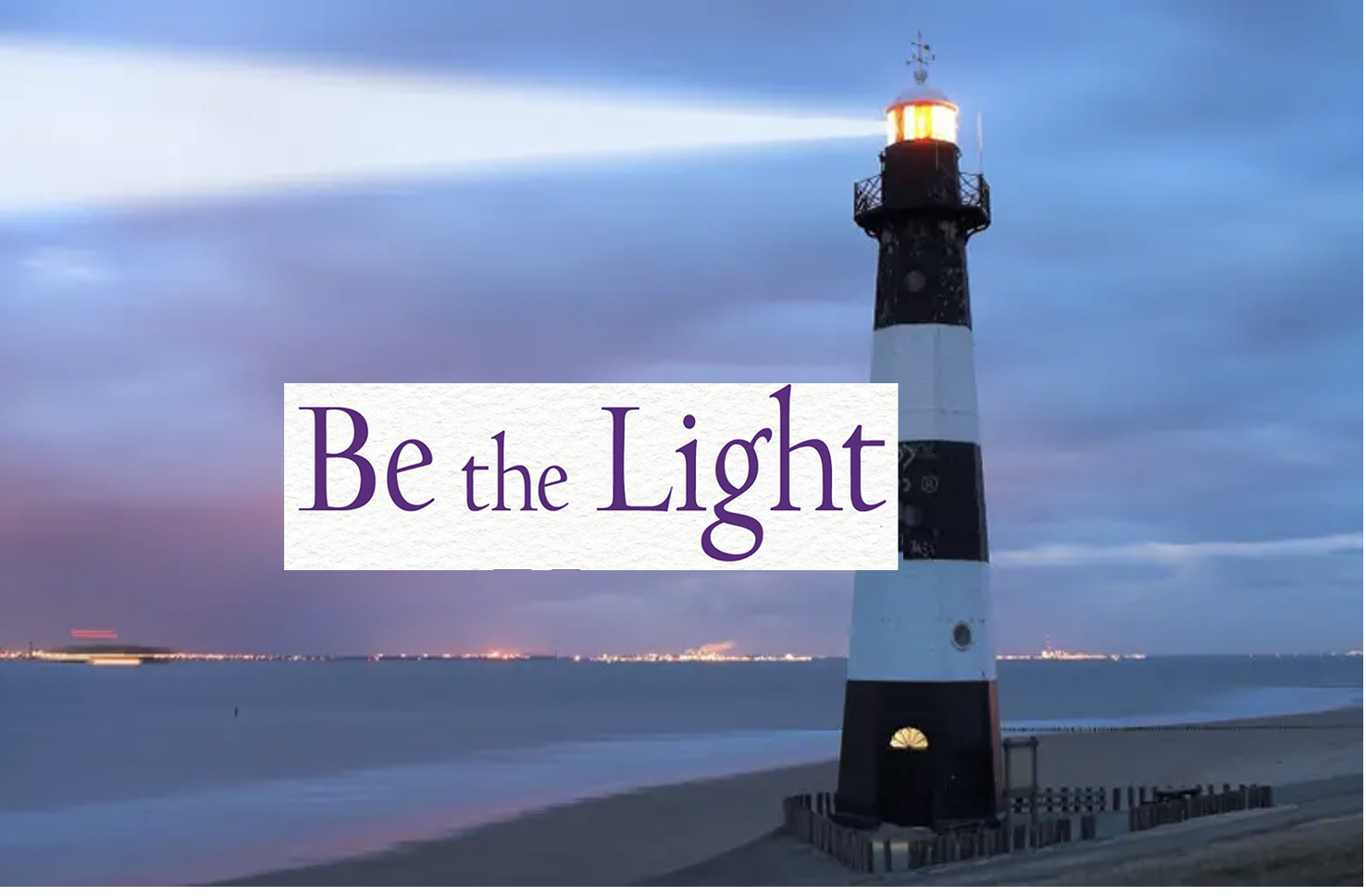 So, what’s the answer when we live in a troubled world, with troubled lives, and troubled kids? The answer is that we still need to be the best we can be individually, an exemplar and example. We don’t have to yield to the trouble and the darkness all around. We can be like a lighthouse shining in a dark stormy night. We can shine and keep shining out, to give others hope, to help others find their way, to be an encourager. In fact, we are needed more to shine now in these dark times than when everything is light and good. It is not the time to hide ourselves away, fearful and timid, hunched over our own devices, living life vicariously glued to television and computer screens, seldom interacting with others except in our small circles of friends and family, drifting away from wholesome social ties with neighbors, friends, church, and community.
Keep in mind Mahatma Gandhi’s wise words: “You must be the change you want to see in the world.” In a world full of problems, become one of the solutions. In a world full of poor examples, be an example for good. You can still make a difference in your world … in yourself and in your relationships with others.
 Back to school time is a good time to think about your life. Where are you going? Are you growing and changing for the better every day, ever learning? Look at yourself in the mirror. Do you look like how you want to look? How does your soul feel? Is your heart happy? Are you giving to the world in a way that makes a difference? You have one life, one precious life to live. Don’t waste time looking back on what you have lost. Life is not meant to be travelled backwards. The life you have now, today, is the reality. You may not be able to control the direction of the wind or many things about the world, but you can adjust your sails and control your own life amidst the storm. You have so much more power and choice than you know. Eleanor Roosevelt wrote: “In the long run, we shape our lives, and we shape ourselves. The process never ends until we die.” Make yourself and your life beautiful.
 Never give up on yourself and decide to simply “settle” with whatever life is dishing out to you. Don’t simply drift along with the norm and negativity of the day. Determine to rise to your best and be your best self no matter what is going on in the world around you. If you don’t decide on a direction and course and row your own boat with purpose, you will just drift down the stream of life, tossed by every rapid in the way, caught in every stagnant pool, taken at will to places you never wanted to go. Studies suggest only 8% of people reach their goals in life. It’s also estimated that only 3% of people set any goals and only 1% write them down. That’s tragic, considering the opportunities we all have in America, even with its problems. That means most people are just drifting through life, going where the stream of life takes them.
 No wonder people are unfulfilled and unhappy, unactualized as Maslow’s findings uncovered, never realizing their own full potential. Our journey is meant to be more productive and fulfilling than that. We are meant to see vision and purpose for our lives and set out to achieve it. Often we achieve in bits and pieces, achieving one goal, then setting another higher goal, accomplishing one small dream, and then reaching for a higher one. Seeing ourselves succeed in small ways builds courage in us to reach for higher goals. People often say, “Oh, I just want the simple life.” A simple life doesn’t mean an unfulfilled, do-nothing life, a sit back and watch the world drift by life. That’s not successful living. It’s a cop out. It’s one of the lies we tell ourselves when we cease to strive, cease to try and give our best to life.
 A man once told me at a book signing, with great pride, that he hadn’t read a book since high school, as though he should be given the Red Badge of Courage for not continuing to be a lifelong learner as we’re all intended to be. A lot of people envision the ultimate life for themselves as a “do nothing” life. A friend of ours was thrilled when he got on disability because that meant he would never have to work again or contribute to society, never have to do anything but pursue his own pleasures. Where do we learn these selfish desires, that we should sit back and drift through life with no goals or purpose? How do you know what God would have had for you to do and accomplish in this world? We are meant to use the talents, gifts, and skills we’ve been given.
 Your own life and your own health are your responsibilities to take care of, to use wisely and well. People live so unhealthy today. They eat poorly, eat the wrong things, and do not get enough exercise and good outdoor activity and sunshine. They sit too much and grow weak in body and often greatly overweight. Excess overweight on your body negatively impacts the health of your hips, knees, ankles and feet. It crowds your organs, slows down your life and strength, keeps you from accomplishing and doing all you want to do. Carrying twenty-five pounds of excess weight daily is like hauling around five sacks of flour or a two-year-old child on your back all the time. While you carry that weight, or more, you have a higher risk for health problems and when that weight packs up to fifty pounds or more, you become a hiring risk for most any job you might want to do, with that weight damaging your good looks and appeal to others. It’s a way many people sabotage their chances for a rich, productive life today. They just don’t have the energy for it after hauling around that extra weight all day.
 To be a light and beacon in the world today, you need to look like one. A beautiful lighthouse distorted in appearance or covered in graffiti is not attractive. Neither are you. If you have decided your appearance, how you look, what your weigh, how you dress, doesn’t have anything to do with your success in life you are living under a false illusion. Your attitude matters, too, and your manners. When I taught psychology courses in college, my students used to get upset at the idea that the jobs open to them, or their likelihood of getting certain jobs or being promoted in them, was directly linked not only to their education and experience but to their appearance and attitude. Somewhere along the way they had developed the concept that they should only be judged by what they were within. That may sound like a sweet ideal but it isn’t the way the world works. In all works you do, you have to deal with the public. Isn’t it simply good, practical sense to assume the public persona you develop and present should be attractive and appealing? That you should look good, dress nice, act nice, and make people glad they crossed your path?
 Frankly, in most every job you’re in, and especially if you rise to a leadership position in any job or endeavor, you become an exemplar to others. Like an ambassador, you represent your occupation, your vocation, company, church, school, or civic group, even your family in how you look and how you act. You are an example and representative for them. What do you tell the world about yourself in how you look and act? What do you tell the world about your vocation, your employer, your family? It is a great deception to believe we can be anything we like, look any way we like, act any way we like, and still be respected and looked up to. So, the place to begin on being all you can be is to work on yourself. Make of yourself the best self you can be. Don’t wait for someone to encourage you to be your best. Encourage yourself. Getting in touch with your true self must be your first priority. “Change is your friend not your foe; change is a brilliant opportunity to grow” [Simon T. Bailey] …”Recognizing that you are not where you want to be is a starting point to begin changing your life.” [Deborah Day]…”Every morning, we get a chance to be different. A chance to change. A chance to be better.” [Alan Bonner]
 The beginning to a better and more productive and happier life starts with you. So encourage yourself… and as you do so, reach out and begin to encourage others. We carry an erroneous idea of what being an encourager means. We think it means to tell someone they are sweet, good, and perfect just the way they are. We think an encourager is a sympathizer, a person who agrees with, understands, and supports our own sentiments or opinions. Wrong. An encourager is a person who inspires, uplifts, and motivates others to gain confidence and pursue their goals. The sympathizer is there with you in the mud, but an encourager throws you a rope to enable you to get out. An encourager recognizes your value and individuality but encourages you to be more. They see your potential. They see all you can be and do and they encourage you, as few do, to step forward, to dream bigger, to overcome obstacles in your path, to find and reach your full potential. Rather than discouraging you and telling you all you can’t be and all the obstacles in your path, all the difficulties in changing yourself and your direction, they encourage you to change and to always reach deeper and higher.
We each have a God-given potential and, sadly, most of us live far below our best level. An encourager reminds you of who you can be, what you can accomplish. They urge you, not to settle into the norm, but to rise to your best. We often like the sympathizers better than the encouragers. We need and yearn for sympathy and empathy when life is hard, when we experience pain, sadness, or disappointment. However, we need encouragers, too, to tell us life can be better, that we can take steps to create a better future, to boost our self-esteem and inspire us to rise above our problems or our apathy, to be more and to do more.
 As summer draws to a close with August moving in and September soon to come, think about your life… how you’re loving yourself and loving the world. Back to school time is a good time to think about what you’re doing with your life. Where are you going? Are you growing and changing for the better every day, ever learning? Look at yourself in the mirror. Do you look like how you want to look? How does your soul feel? Is your heart happy? Are you giving to the world in a way that makes a difference? You have one life, one precious life to live. Don’t waste time looking back on what you have lost. Life is not meant to be travelled backwards. The life you have now, today, is the reality. You may not be able to control the direction of the wind or many things about the world, but you can adjust your sails. You have so much more power and choice than you know. “In the long run, we shape our lives, and we shape ourselves. The process never ends until we die.” [Eleanor Roosevelt] Make yourself and your life beautiful.
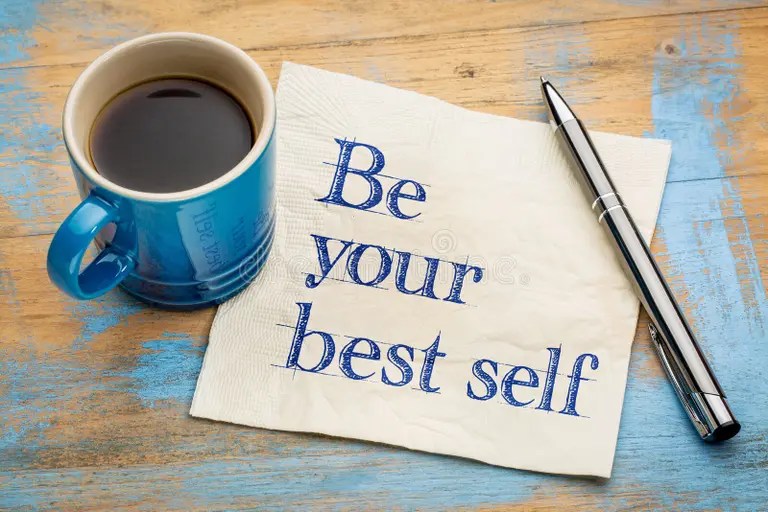 That old song “You can’t be a beacon if your light don’t shine” has a spiritual note, too. As a person of faith, who walks close to God, I can assure you that God wants you to shine strong, sweet, true, and good in this dark world. He will help you, too, if you begin to reach out and ask for His help. But He won’t do it for you. He won’t fix it for you. “Faith without works is dead” [James 2:14] and God expects your full effort and cooperation in the process of making you all you should be and could be in this one precious life you have. God will help you to become your best self. He created us and knows the best way and plan for our lives, so He will naturally strengthen, encourage, and help you in the journey to be all you can be in life. God will intervene and renew and help even in situations that seem desolate and too hard to us. From Genesis on in the Bible, God said “Is anything too hard for the Lord?” [Genesis 18:14], reminding us that God’s help can be a great asset in becoming our best in this life, in encouraging ourselves in a dark world, in encouraging others, and in being a light and exemplar in our world.
 The times may be a changin’, the times may be dark, but you can always change yourself for the best if you will, you can always learn, grow, and seek to know more, you can always encourage yourself and encourage others, too. It’s never too late for good change, to envision and build dreams and goals and to work for them, to live a good and satisfying life. The idea that it’s too late will always be a mental barrier and be assured that others will try to tell you of all the reasons your dreams and goals won’t succeed. Don’t listen. Don’t dwell on missed opportunities or problems of the past. Take courage, Take action. Let this coming year be your year for change. You can do it. You are not here in this life to be mediocre. …Believe in yourself and you’re halfway there. …”If we did the things we are capable of doing, we would literally astound ourselves.” [Thomas Edison]… And remember, what you have to give, the world needs….”Don’t let anyone dim your light. You were born to shine” [Kirsten Ferguson].
________________________________________________________________________________________
Note: All photos my own, from royalty free sites, or used only as a part of my author repurposed storyboards shown only for educational and illustrative purposes, acc to the Fair Use Copyright law, Section 107 of the Copyright Act.
 …OBSERVE the beauty all around you and really notice the changes in nature this month. Depending on where you live, the weather will grow cooler and crisper, and the leaves, here and there, will begin to turn color to their autumn splendor. If you will slow down and stop to notice it, nature can do wonders for your mood, lifting your spirits and reminding you that there is still so much beauty in the world to enjoy. “Some old-fashioned things like fresh air and sunshine are hard to beat.” [Laura Ingalls Wilder] …”A walk in nature walks the soul back home” [Mary Davis]
 … CALL and catch up with someone you love but haven’t talked to in some time. It’s always sweet to hear an old familiar voice of a relative or friend you once shared lovely seasons of your life with. In this busy world today where we’re often more impersonal on social media or via texting, it’s a delight to sit down in a comfortable chair in a quiet corner and just talk and laugh with someone on the phone. “Time is everlasting, but people aren’t. Keep in touch with people you love” [anonymous] “You can’t go back and change the beginning. But you can start where you are and change the ending” [C.S. Lewis]
 …TRAVEL more and become an adventurer. Plan a trip, small or large, and go somewhere you’ve never been before. Be bold. Decide on some place you’d love to see or visit,… an interesting city, a state park, a quaint resort town. It can be in state, out of state, or out of country. Then research about it on the internet. Pick up books about it at the library. Get maps and brochures from a visitor center. They are lovely to mail them to you. And make your plan. Break out of the ordinary and do and see something new. “Travel brings power and love back into your life” [Rumi]. “Adventure is always worthwhile” [Aesop].
 … OPEN your eyes to new opportunities this month. Get out of your comfortable and familiar patterns. Consider trying a new activity… take a class, join a club, become a volunteer, discover a new hobby, get creative with an art or craft. Find a way to use your talents. Discover a way to be a blessing. Get involved in a worthwhile effort. Don’t wait for someone else to suggest something fresh and new you can try. Step out on your own. “Opportunities don’t happen, you create them” [Chris Grosser] “Do not wait until the conditions are perfect to begin. Beginning makes the conditions perfect” [Alan Cohen].
 …BARGAIN shop more, be frugal, and spend less. People spend too much money today. They buy more than they need and struggle to make ends meet. Inflation is a factor but experts say its more about poor budgeting and money management skills—not shopping wisely, over spending, and being unwilling to make do with less. Bargain and thrift shopping can save a lot of money and be fun. But truthfully, we need to stay out of debt and “Stop spending money we don’t have” [Paul Ryan]. As Will Rogers said in humor: “Too many people spend money they haven’t earned to buy things they don’t want to impress people they don’t like.”
 …ENCOURAGE someone who needs it and encourage yourself, too. The world is full of critics and hatefulness today, and people are hungry for a kind and encouraging word. Be the person that smiles at strangers, that grins at your friends and makes them laugh, that tells someone with sincerity, “You’re talented. You’re smart. I know you can do it.” We could all use someone who looks for the best in us and sees the good in us, instead of the worst. “Always be generous with your encouraging words; you may find they will inspire others to be the best they can be” [Catherine Pulsifer] “It’s amazing what a little encouragement can do.” [Winnie Harlow].
 …READ more. Renew your mind, recharge old knowledge you’ve forgotten. Purpose to read and learn new things every day. Strengthen your mind and the wisdom you carry. An old quote says “The moment you stop learning is the moment you start dying.” That fact is certainly true for your brain cells. They die out from disuse. If you want to stay mentally strong and powerful, read and educate yourself for all your life. Countries and its people stay strong through reading and continuing learning. “The purpose of learning is growth, and our minds, unlike our bodies, can continue growing as long as we continue to live” {Mortimer Adler] “Read to learn and read for joy” [anonymous].
 On September 15th our new guidebook, TRAVELING GEORGIA PARKS, publishes. This is our fifth travel guide, including our Smokies hiking guide and it is our fourth state parks guidebook. Our first, DISCOVERING TENNESSEE STATE PARKS, started our journey of visiting state parks. We learned with that book there was no book about all of Tennessee’s parks written by someone who had visited them, only fill-in journal books or books highlighting a few parks with other content. So, we set out to visit in person every park in Tennessee so we could tell readers about all the fun things to do and see in each park in the state and we included photos from every visit, putting over 700 color photos in our book, too. The book was so successful that we began to get requests to create guidebooks for other states. This resulted in lots of lovely travels around the southeast visiting parks to create EXPLORING SOUTH CAROLINA STATE PARKS and VISITING NORTH CAROLINA STATE PARKS, and then last summer between May and the end of September we traveled all over Georgia to 66 state parks and historic sites for our new Georgia parks’ guidebook.
 So many of our parks throughout America would not be here at all if it weren’t for the vision and work of President Franklin D. Roosevelt for establishing them, and we had a little chance to thank him for that when we visited the F.D. Roosevelt and Warms Springs parks near his Georgia home and found his lifelike statue at Dowdell Knob.
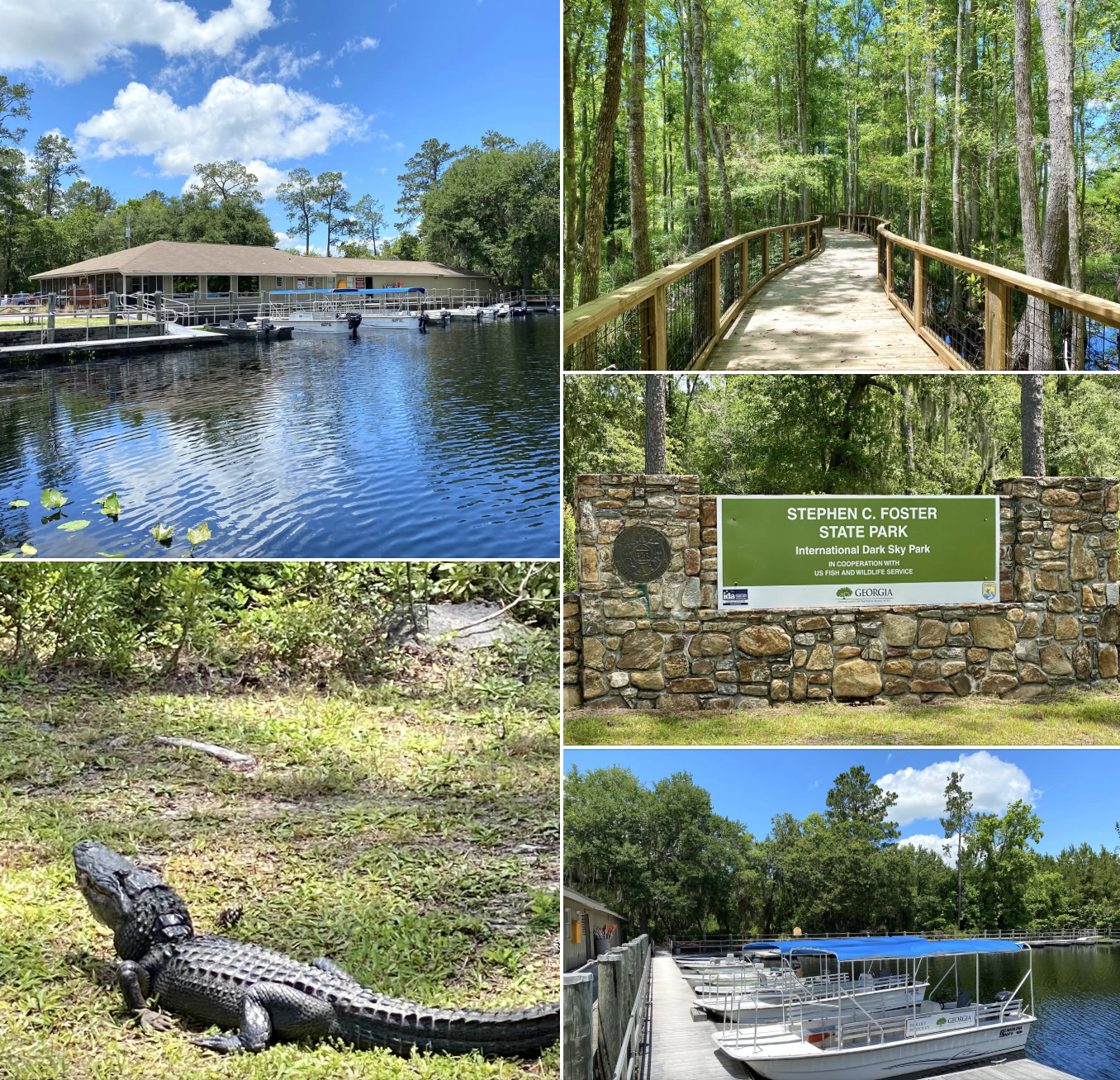 COASTAL GEORGIA covers the region from Savannah down to St. Mary’s near the Florida border and east across part of the southern region of the state. For this area, with the multitude of parks along or near the Atlantic Coast of the state, we rented a condo for a week in early May at St. Simons Island, Georgia, and used that point as home base for our park visits. The first park we visited was Crooked River State Park in St. Mary’s, along a tidal river leading out to the sea, and then we drove back into Florida’s 402,000-acre Okefenokee Swamp to the Stephen S. Foster Park. As you see from the photos, the park was tucked along lake and marshlands with boardwalk trails leading through cypress trees growing out of the water, with rich wildlife, birds, and alligators. Visitors can take boat tours into the swamp, stay at the park’s campgrounds or cabins and visit other areas around this ecologically diverse area. Each day after was a continual adventure as we visited at least two parks a day up the coast or inland, exploring beautiful parks like Skidaway Island State Park, Fort McAllister State Park, and a multitude of historic sites like the Reynolds Mansion on Sapelo Island, Fort Morris and Fort King George.
 MIDLANDS GEORGIA spreads above the coastal region, reaching back into the heart of Georgia. There are less parks here, all more spread out, and we had a chance to travel parts of Georgia we’d never seen, often past miles and miles and miles of pine tree forests. We now know where all the telephone poles of the south come from!! In this region we discovered broad, beautiful parks tucked around scenic lakes like Jack Hill, Little Ocmulgee, and Magnolia Springs built around a historic springs that has bubbled up clear waters from below the earth for thousands of years. A favorite park here was General Coffee State Park because of its diversity. It offered campgrounds, cottages, hiking, an idyllic lake, as well as boardwalks leading back into a cypress swamp and a wonderful Heritage Farm, full of historic log cabins, barns, and farm animals.
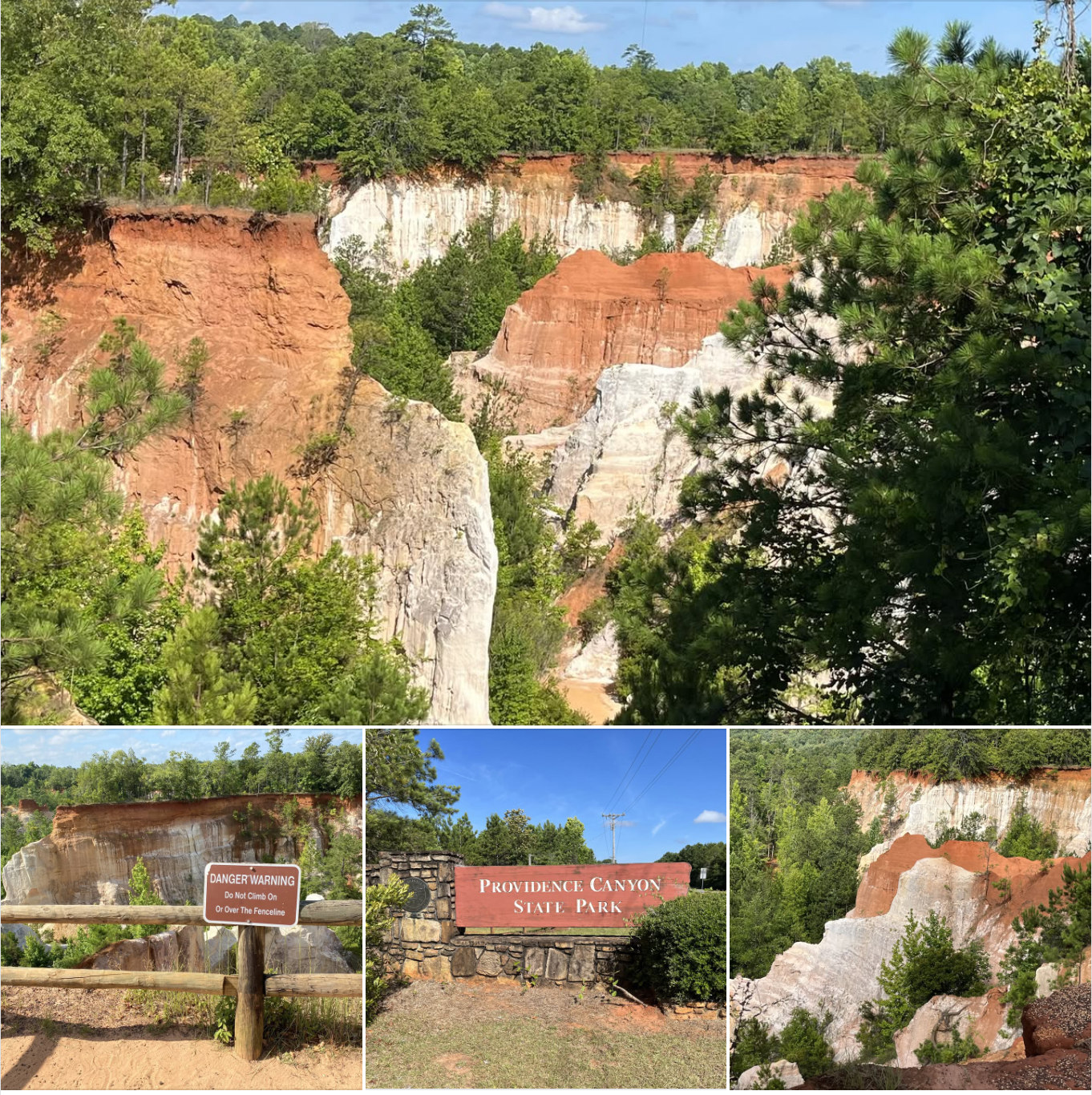 THE SOUTHWEST REGION we visited in summer took us across the state to visit parks from Georgia’s border with Florida, like Seminole State Park, to lovely parks along Lake Eufala on the Alabama border like the George T. Bagby and Florence Marina parks to inland treasures like the huge Georgia Veterans State Park and Resort. Further north we visited parks like the F.D. Roosevelt State Park tucked in the mountains near Callaway Resort, where J.L. and I spent our honeymoon. A favorite park in this region, and certainly an unexpected one, was Providence Canyon. We felt like we were visiting the Grand Canyon out west and this unique park is called the Grand Canyon of the South and is one of Georgia’s Seven Wonders. So don’t miss visiting this one!
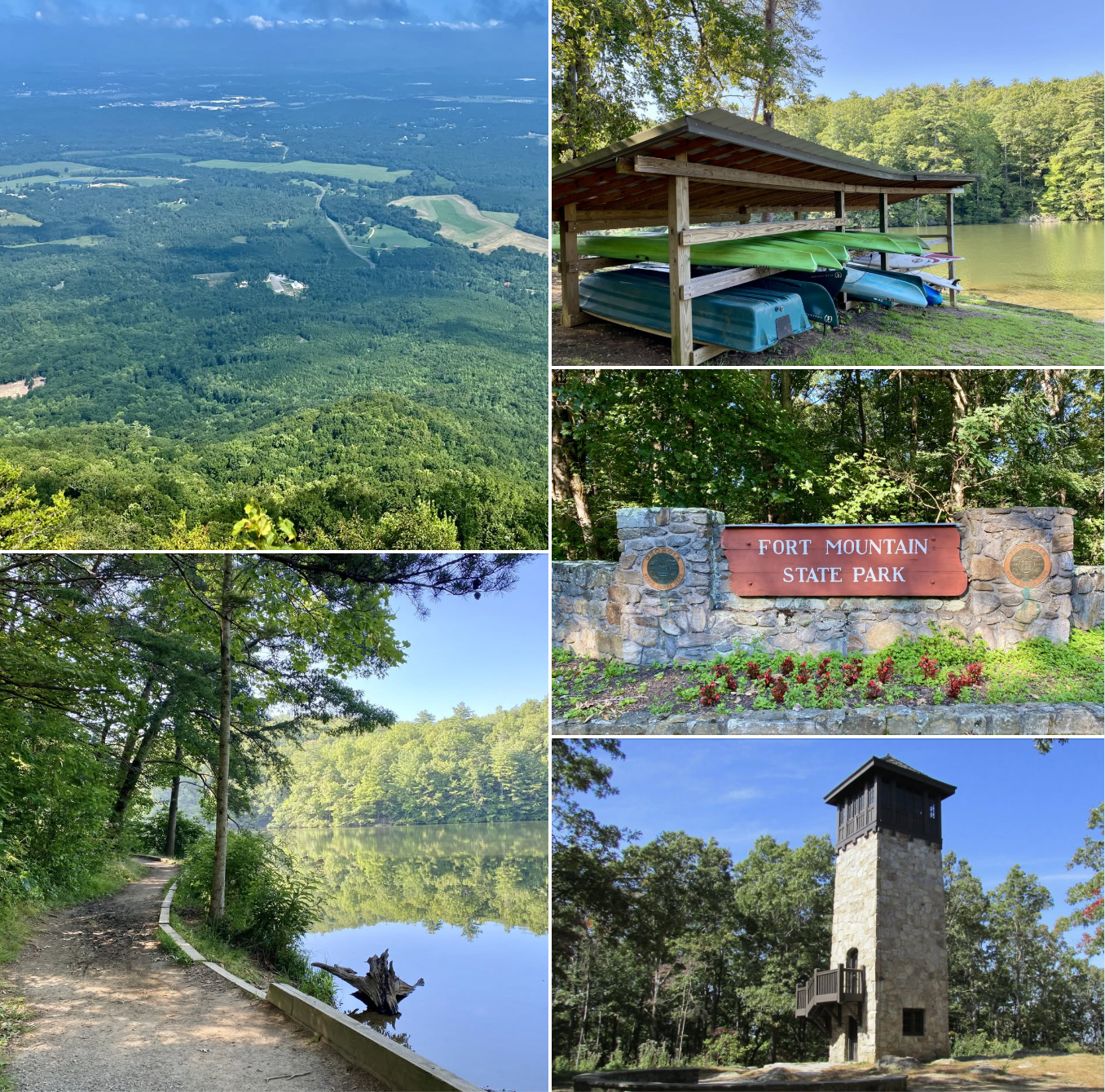 The NORTH MOUNTAINS region lies in the northwest section of the state, bordering Alabama and Tennessee, and it holds a large number of parks with a wide diversity. We visited parks near Atlanta like Sweetwater Creek, Chattahoochie Bend, and Red Top Mountain and others further north like James H. Floyd and the stunning Cloudland Canyon State Park with its fabulous views. A favorite mountain park we had never visited before was Fort Mountain State Park high in the Cohutta Mountains near Chatsworth. It covers over 4000 acres and offers lakeside pleasures, a fine campground, scenic overlooks, and some especially interesting hiking trails rising to excellent views.
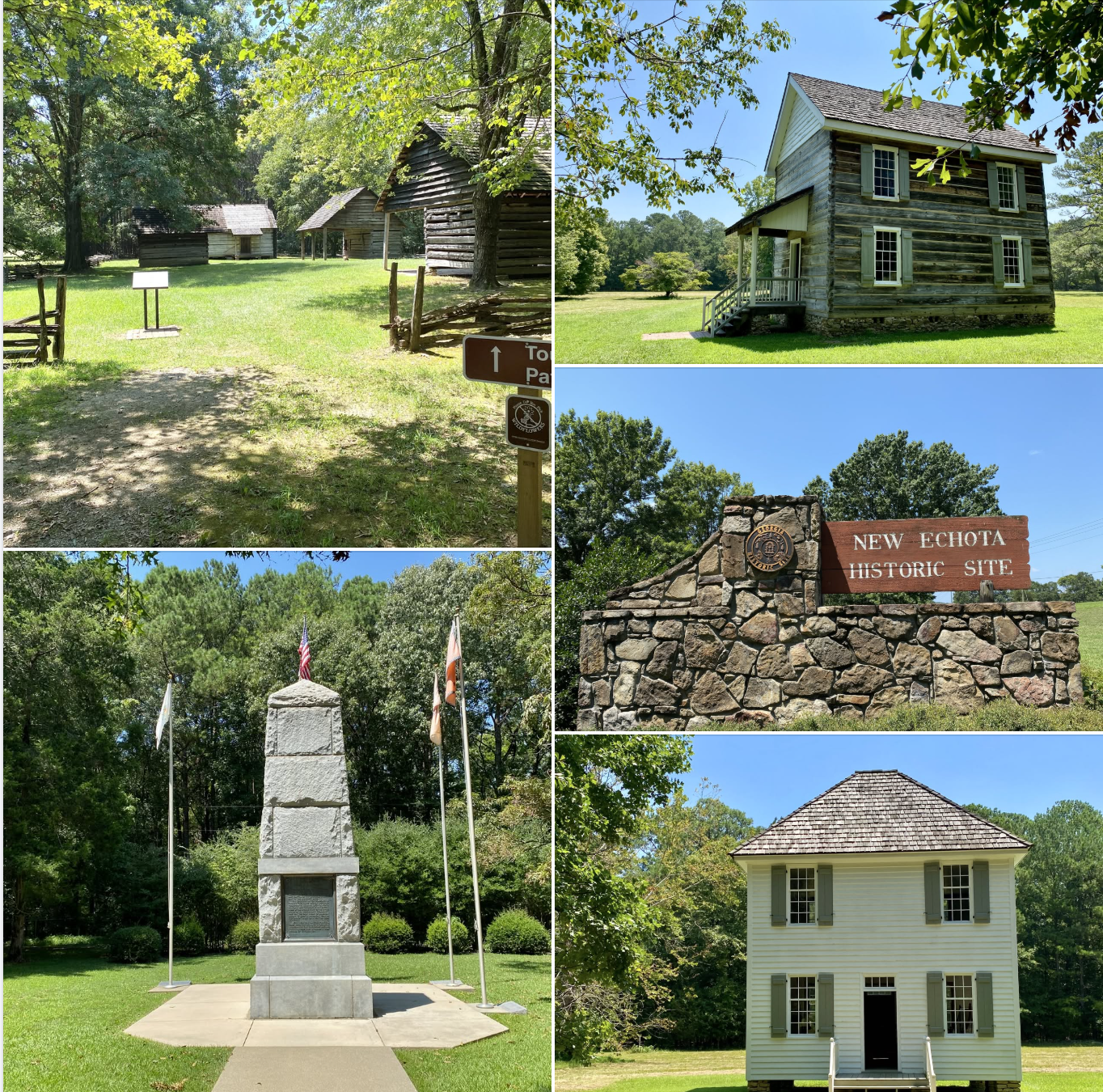 Throughout our parks’ regions, we visited many interesting historic sites, learning so much about American history, Georgia’s own history, and about famous men and women and their accomplishments we hadn’t learned of before. I do hope that as you visit around Georgia, or in the parks in other states, that you’ll take time to see the many sites where the states work hard to preserve our history. One site we especially enjoyed visiting in the North Mountains area was the New Echota State Historic Site in Calhoun, Georgia, easy to get to from I-75 South. New Echota served as the capital of the Cherokee Nation from 1825 to 1838 and visitors can learn so much about Cherokee history here at the museum and in walking around the grounds of the original and reconstructed buildings that held significance to the Cherokee people.
 Georgia’s PIEDMONT REGION, somewhat like the Midlands Region, stretches across a middle area of Georgia from the South Carolina border to areas south of Atlanta. We visited lovely Mistletoe State Park, Hard Labor Creek State Park, and a wide variety of historic parks. Two favorites were Indian Springs State Park and High Falls State Park. Indian Springs was one of the state’s first parks, established around an old natural spring beloved first by the Indians and then by visitors in the Gilded Age. You can visit the spring house, learn about this park’s rich history, and enjoy its fine lake, campgrounds, cottages, and rich amenities. High Falls State Park is only fifteen minutes away, with the highest waterfall south of Georgia, so it is easy to visit both parks in a day.
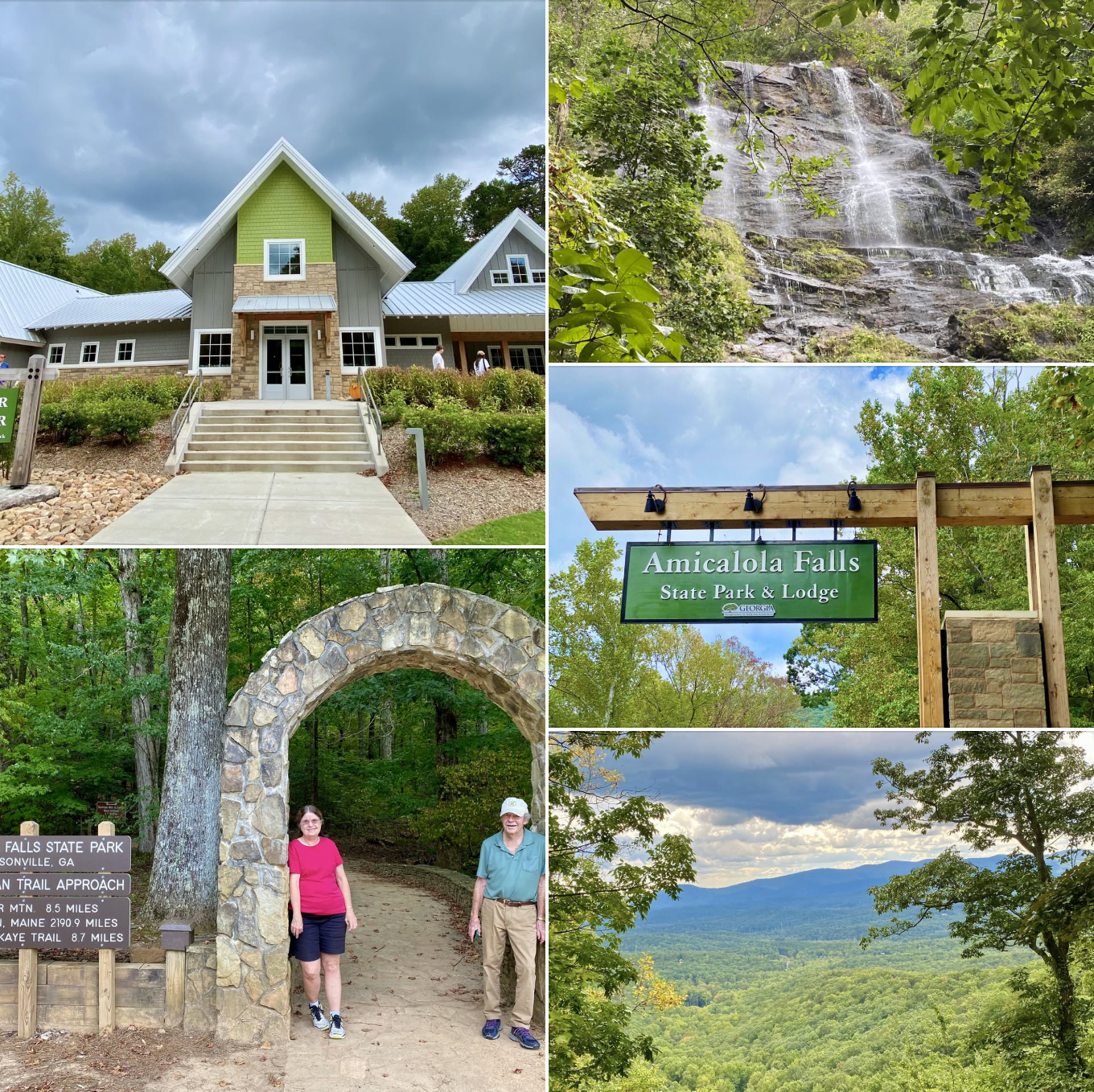 The last Georgia parks region we visited, the BLUE RIDGE REGION took us closer to our home and the familiarity of the mountains. The Blue Ridge Region has more parks than any Georgia state region and it took us two different week-long trips to visit and explore them all. Some of the parks lay near the midlands region like Fort Yargo, Don Carter, and Victoria Bryant while others nestled along South Carolina’s border or near the Tennessee and North Carolina borders. We loved the parks in this area, enjoying visiting Tallulah Gorge State Park again, Black Rock Mountain and Unicoi. Visits took us to many historic sites, too, like to the Dahlonega Gold Museum and Hardman Farm. A special favorite was our visit to Amicalola Falls State Park with its incredible 729-foot waterfall, glorious views and overlooks. The park has a new visitor center rich with displays, and the rock entrance to the Appalachian Trail Advance behind the center, where many begin the long hike 2100.9 miles of the Appalachian Trails from Georgia to Maine, is a popular spot for photos.
 For every park in our Georgia guidebook, we provide clear directions to get to each park, a description of all the interesting and diverse things to do and see in every park, plus we often include a History Note when appropriate to add to your understanding about the history of that particular park, along with our photos. …. I hope you’ll order one of our new Georgia parks books and plan some visits to the state’s diverse variety of parks soon. You can purchase our other guidebooks, as well, through your favorite retailers in-store or online to the states of Tennessee, North Carolina, and South Carolina for more park adventures. J.L. and I hope you’ll enjoy your parks visits to Georgia as much as we did … and if you enjoy these guidebooks, please pop over to Barnes & Noble or Amazon to leave a review and consider buying some extra copies for Christmas gifts.
 There are a wealth of books, articles, and online sites filled with advice for attaining better health and living a better life. All too many lead to a “money trail”—something that someone wants to sell you that you should buy, a seminar you should go to for a big fee, a drug you need, or an expensive service only they can provide. However, for most of us, we’re just looking for some common-sense ways to sort out all this advice to find a few ways we can live healthier and better every day.
 A massive collection of research shows that living with a positive versus a negative outlook on life, expecting the best not the worst, and focusing on the good in life more than the bad and problematic enhances your well-being. Most of our daily outlook is an acquired habit we’ve fallen into and habits can be changed. Study the research. Get books on positive thinking and positive living to read. Make a quality decision to re-focus your thinking daily.
 Not only are you “what you think” and “what you speak”, you are “what you eat.” A huge body of research shows the American diet has become unhealthy. A large percent of Americans eat in unhealthy patterns, consuming too many processed foods, heating up too many pre-prepared meals and foods full of additives, not cooking healthy foods at home and eating out too much. Three simple meals a day, breakfast, lunch, and dinner, with about a 12-hour break between dinner and breakfast again, is still a healthy habit to cultivate.
 The human body is 55-60% water. Over half of all Americans, according to countless studies, are chronically dehydrated and don’t consume enough water to maintain good health. This forces the body to circulate the same dirty water around through the system, impacting health and elimination negatively. Think of it like leaving your garbage around the house and not taking it out. Water in your body is the garbage eliminator. So drink your 6-8 glasses of water daily. It’s a good habit to cultivate. It will keep all your bodily functions generating at their peak, aid digestion and elimination, strengthen attention and cognitive ability, support organ function and promote overall well-being. Do some reading on the importance of water to your body and up your water intake.
 It is a simple fact that if you don’t move and exercise your body, it will grow weaker. If you have ever been snowbound or forced to stay indoors and inactive for a couple of weeks, you probably noticed you were physically weaker after such inactivity. “Move it or lose it” applies to our physical well-being far more than we know. If you don’t find ways to actively keep moving your body, it will grow weaker. The more sedentary lives most Americans engage in today are hurting the health and well-being of Americans dramatically.
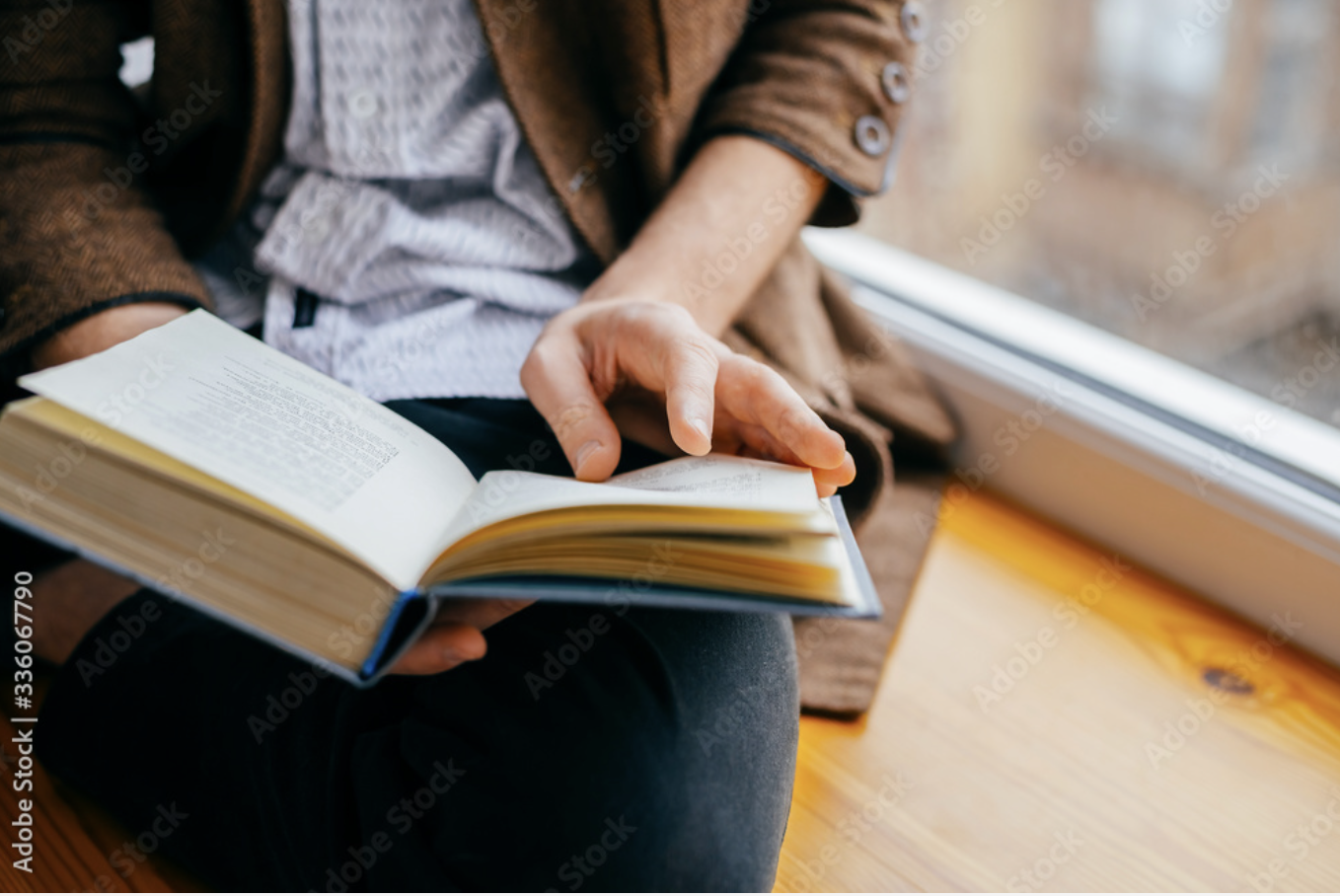 “Use it or lose it” applies to the mind as well as the body. Using your mind and continuing to actively learn new skills and gain new knowledge strengthens neural pathways in your brain associated with memory formation and retrieval. It keeps the brain working optimally and studies show that lifelong learning is positively associated with reducing the risk of developing dementia and other cognitive disorders. An unused mind begins to atrophy. We are meant to be lifelong learners, not ceasing to read, study, and learn daily after we graduate from school. Cultivate engaging your mind through learning and mental activities. Be a hungry learner. Read daily. Study topics and books of interest. Increase your education all of your life, via classes or on your own. Even Seneca wrote long ago: “You should keep learning to the end of your life.” And the Bible in Proverbs affirms: “Seek wisdom; it is the principle thing.”
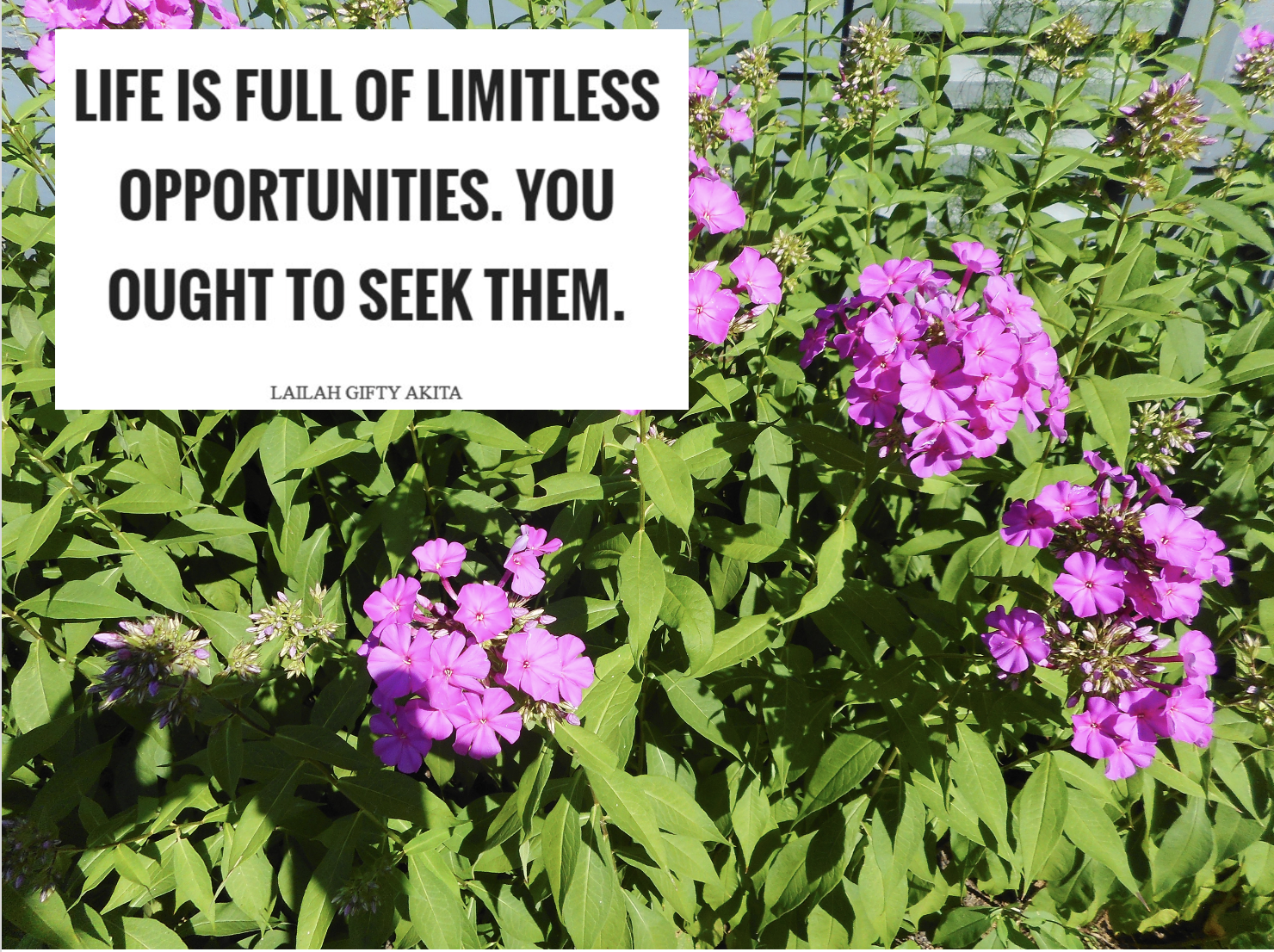 We were never meant to sit around idly, whiling away our days uselessly, goofing off, watching television, doing little of value or purpose. The old proverb “Idle hands are the devil’s workshop” is still true, and an idle life leads to depression, poor health, too much self-focus, and declining mental acuity. We were meant to serve in this world, to be useful, to set goals and work to achieve them, to live purposefully. Follow your dreams. Find your purpose in life. Set goals for your days and your future. Pursue the goals and dreams your heart calls you to. Don’t settle for mediocrity and a low level of life. Always be eager to reach higher, to do more and be more. Be brave in every day. Step out. Do things you’re scared to do and persist even if no one encourages you.. Richard Evans wrote: “Don’t let life discourage you; everyone who got where he is had to begin where he was.”
 Additionally, develop your faith. Multiple studies reveal people with a strong faith in the Lord live longer and stronger. So growing in your faith should be one of your daily purposes and goals. It will aid you in every aspect of healthy living, helping to give you the victory over daily struggles you encounter, encouraging you with your goals and dreams. In every day try to be a blessing to yourself and to others, too. Like the old song lyric: “You can’t be a beacon if your light don’t shine” … Keep your faith and your light shining bright. Live with goals and purpose in all that you do for all of your days.
 The term genre is pronounced john-ruh with the accent on the first syllable. The word genre, in a broad sense, means a category of artistic composition, as in music or literature, characterized by similarities in form, style, or subject matter. It comes from a French word meaning “kind” or “type.’ Book genres are broad categories that classify literature by content, themes, tone, technique, and style. The idea of genre classification is to place works that are similar into groupings with shared conventions. Most every book genre can be further divided into subgenres, creating a diverse range of reading categories and experiences. Some sources suggest there are up to fifty genres, while others argue for far less, noting the main four genres as poetry, fiction, nonfiction, and drama. Even the ALA, the American Library Association, doesn’t define a specific set of “main” genres for books.
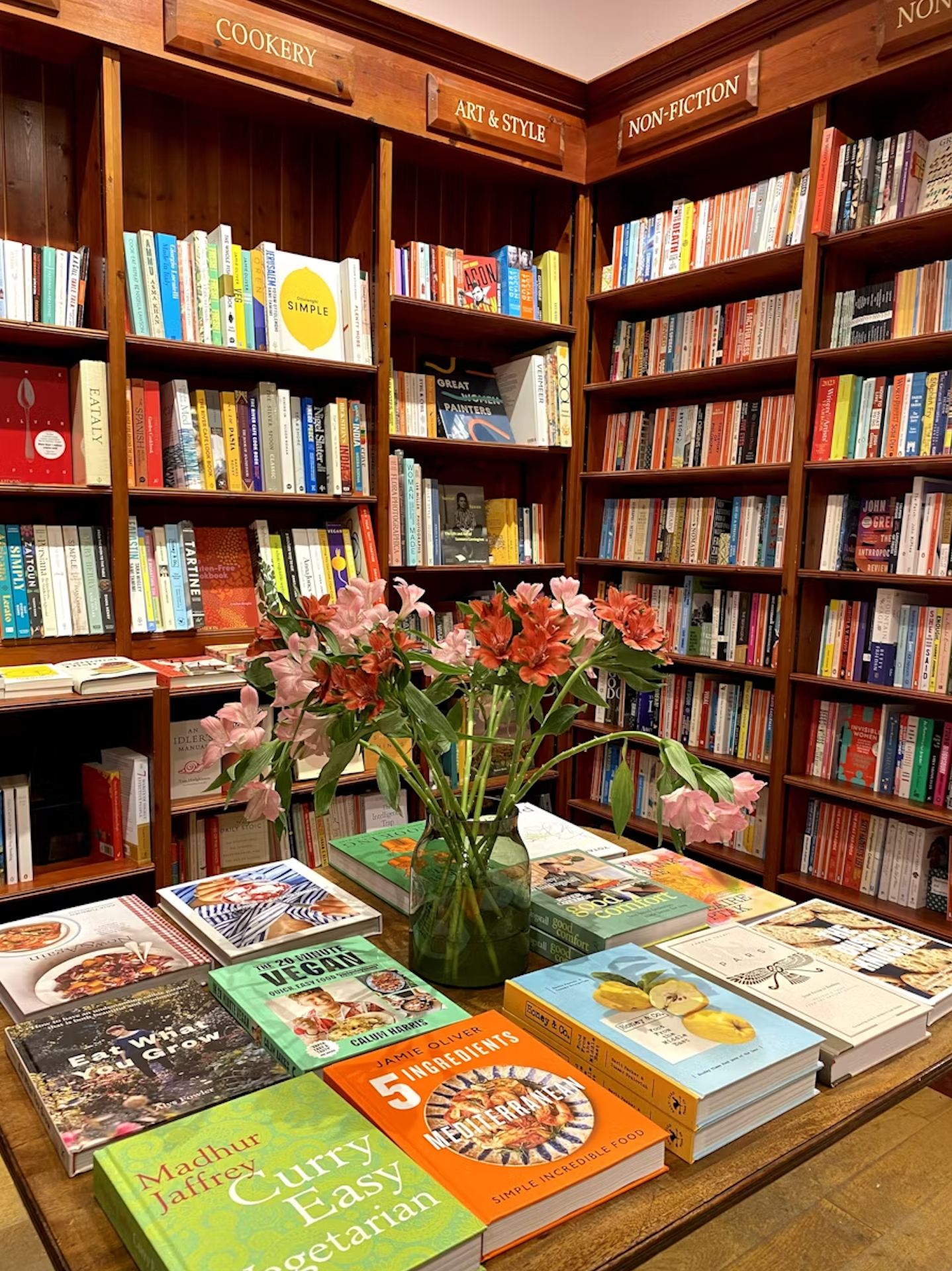 When I think of book genres, the two primary types I learned in growing up are Fiction and Nonfiction. Fiction books are imaginative narratives with plot, characters, and settings created all or in part from the author’s imaginative mind, and are meant to entertain, explore themes, and evoke emotions. Nonfiction books are an account of facts, based on real lives or real events, and are meant to teach, provide insights, explain, or convey information. Non-fiction authors strive to be truthful and accurate in representing the facts as they occurred or in telling about the subjects or people they are writing about. Fiction authors can create any story they wish, based on their imagination, although, of course, they want it to be compelling and engaging.
 In the “fiction genre,” are many primary and subgenre categories. For example in the Romance genre category are many subgenres including contemporary romance, historical romance, Regency romance, romantic suspense, romantic comedy, paranormal romance, and others. Under the Mystery genre are multiple subgenres, too, including classic or traditional mysteries, cozy mysteries, historical mysteries, courtroom mysteries, detective fiction, and psychological thrillers.
 In the “nonfiction genre,” another very broad category, are personal life stories, biographies or memoirs, and stories about persons written by a third party, called autobiographies. There are many nonfiction books geared to life, interests, and hobbies, including cook books, diet books, and other titles related to nutrition and health, decorating and home books, art and photography, travel, history, humor, or true crime accounts. In addition, there are how-to titles of all kinds from non-fiction books about child-rearing, parenting, family life, self-help books, humanities and social sciences titles, and science and technology books on nearly every subject. There are also non-fiction books for children, new age and spirituality titles, and a wide array of Christian non-fiction books.
 I read a lot of non-fiction books. Most relate to my fields of study in psychology and research or to knowledge I need for my teaching or writing. Others are chosen for self-help, growth, and inspiration. I read to teach myself to carry a positive and productive attitude, to deal better with others, to be more effective in the world. I read spiritual books, too, to grow in my Christian faith, which I never want to let grow stagnant. I think it is more obvious how that type of book impacts us … but “fiction” books impact us, too.
 You probably smiled as you saw a mention of particular genres or subgenres of Fiction book types you particularly enjoy reading, and you can probably name authors and book titles in some of those areas you enjoyed reading over the years. Fiction books can deeply influence and impact us and books can stay in our hearts and memories for many years, often throughout our entire lives. We remember specific characters, settings, or happenings in plot that made them special to us, and we often reread these favorites again along life’s way.
 When I was a child, picture books weren’t as abundant and popular as they are now. After World War II in the 1950s and 1960s, the publication of children’s books began to rise with the after-the-war birth rate and advances in the publication industry. However, it took time for these new, lavishly illustrated books to move into the homes of families. Children growing up then were encouraged in education and read to more than in past, but books in the home tended to be more storybook collections with many stories tucked within one book, like The Better Homes and Gardens Storybook I still own. In it were books and stories like Peter Pan, The Little Red Hen, The Story of the Live Dolls, and The Tale of Peter Rabbit.

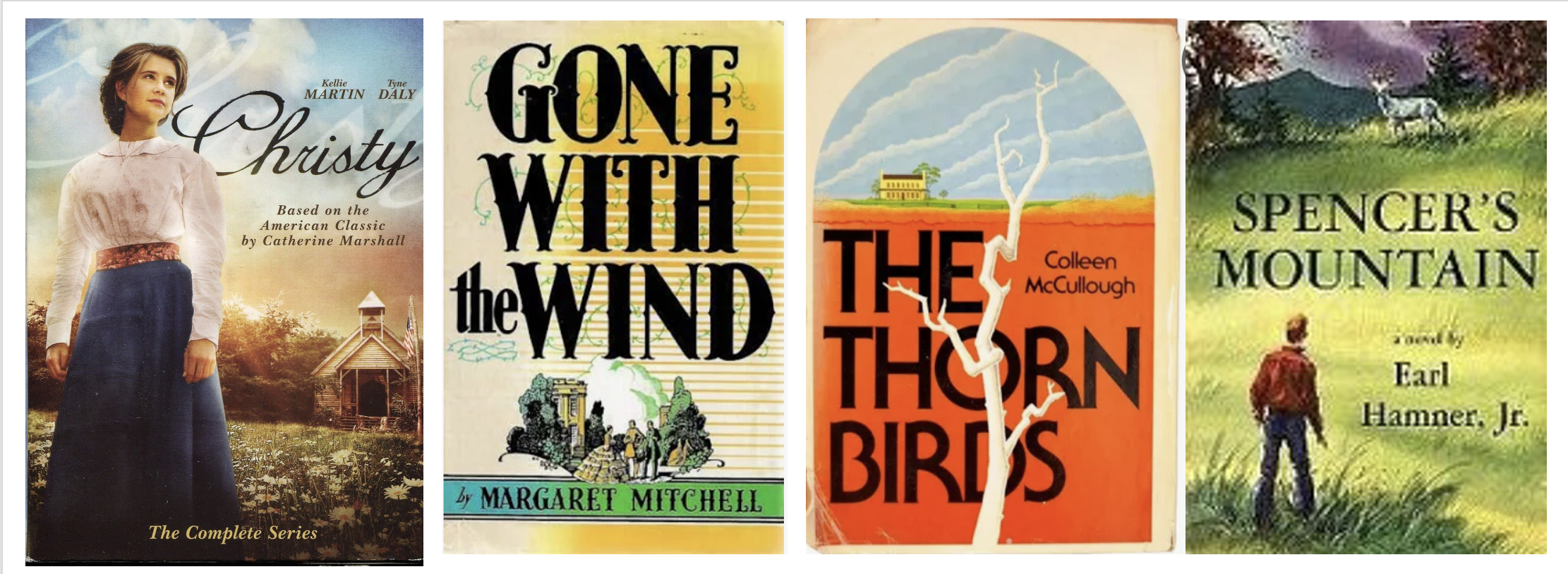
 I began to dream of writing while reading so much as a girl and young woman. I thought how wonderful it would be to write books like Eugenia Price’s novels set along the South Carolina coast with rich characters and beautiful settings or to create warm-hearted books like Jan Karon’s lovely Mitford books set in a small town in the mountains. I found and devoured Mazo de la Roche’s The Jalna books and Colette’s Claudine books, following the lives of their characters. Looking back, it’s hard to remember just why those books resonated so much with me, but I knew, even then, if I ever got to write books that I hoped they would be books like these.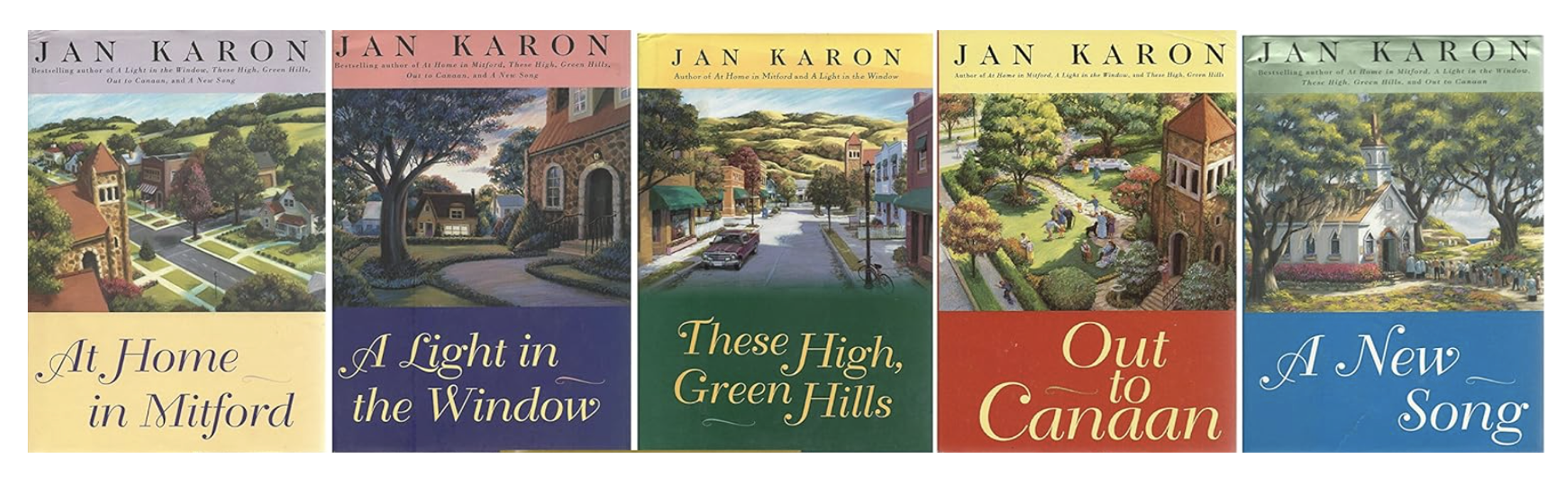
 I write now because I love to write and I write to share the love of good, rich, wholesome and warm-hearted books with you … and I hope my stories will impact you only in good and positive ways.
 May is a month rich with flowers. We love seeing them as we travel around the areas where we live, when we visit gardens, send or receive flowers, or simply walk outdoors, stopping to admire them. Flowers have also long held meaning… and in past, especially, people gave floral gifts to convey messages or meanings as well as simply to bring another person joy. The term “floriography”, meaning “The Language of Flowers” is the name for the system developed to convey messages and emotions about flowers. Especially in the Victorian era, flowers served as a way to express feelings. Most of us are familiar with birth flowers for every month of the year or we might have read legends about the names and meanings of certain flowers. A lot of Shakespeare’s work involved flower symbolism. However, for most of us, we know little about the meaning of the flowers we send, receive, or enjoy.
 While cleaning out book shelves, I discovered a little book called Kate Greenaway’s LANGUAGE OF FLOWERS. This small book, that used to be my mother’s, further inspired the idea for this blog. The book was an old one, published before copyright dates, and I loved leafing through the sweet illustrations created by English Victorian artist and writer Kate Greenaway (1846-1901). She gave the meanings of many flowers in the book, plus messages that flowers once conveyed, and I further researched to learn more. Below is a sampling of what I learned about some popular flowers you may be familiar with. The flowers I’ve chosen to use have mostly sweet meanings and messages … but many flowers can send a different message altogether, probably sent anonymously. Some plants and flowers could be sent to convey messages like: “I shall not survive you,” “Love is dangerous,” or “Justice shall be done to you.” Others could mean “You are cold,” “Your looks freeze me,” or “My love is hopeless.” Flowers often held both sweet positive meanings and negative, somewhat warning meanings. If you were the receiver of a bouquet of red and yellow chrysanthemums with no recipient name attached it could mean “I love you “ for the red” or “Slighted love” for the yellow!
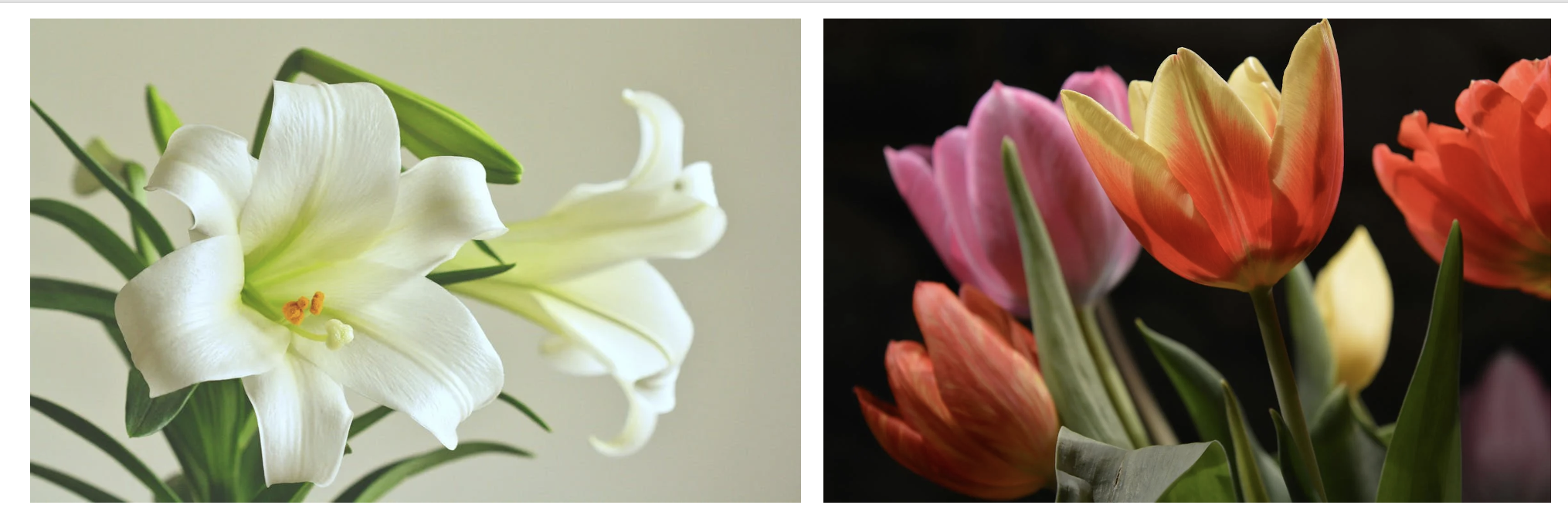
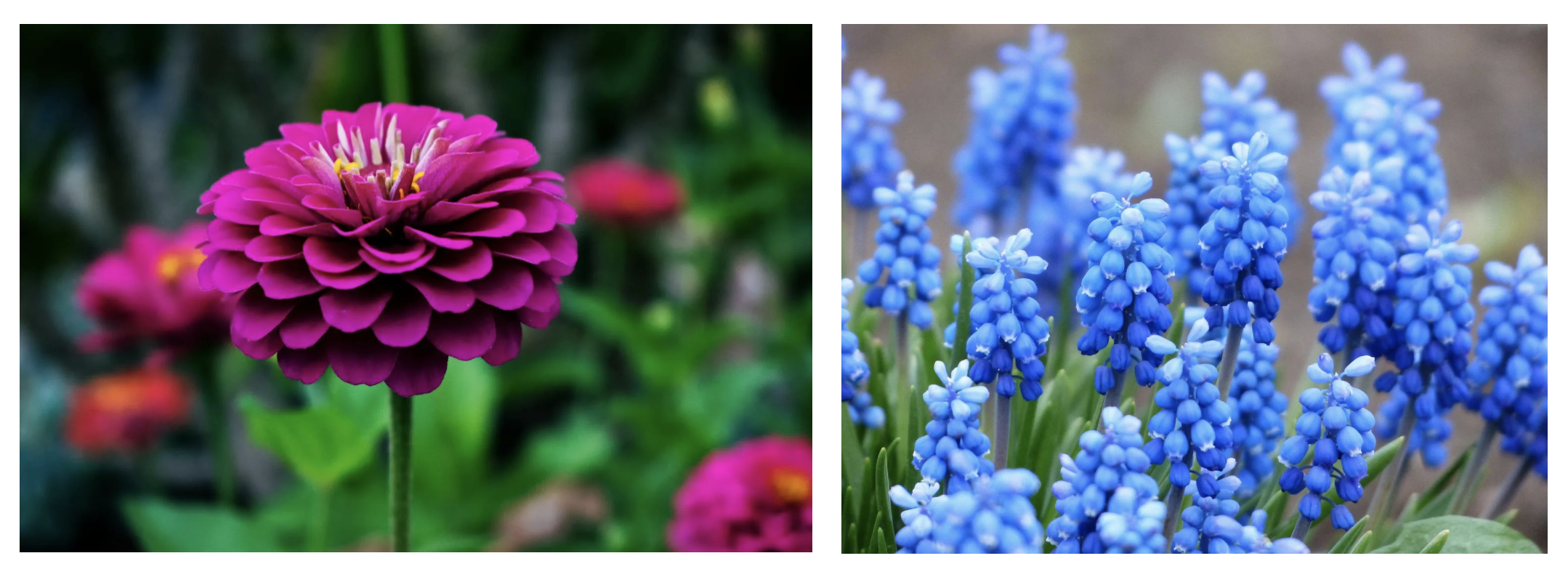


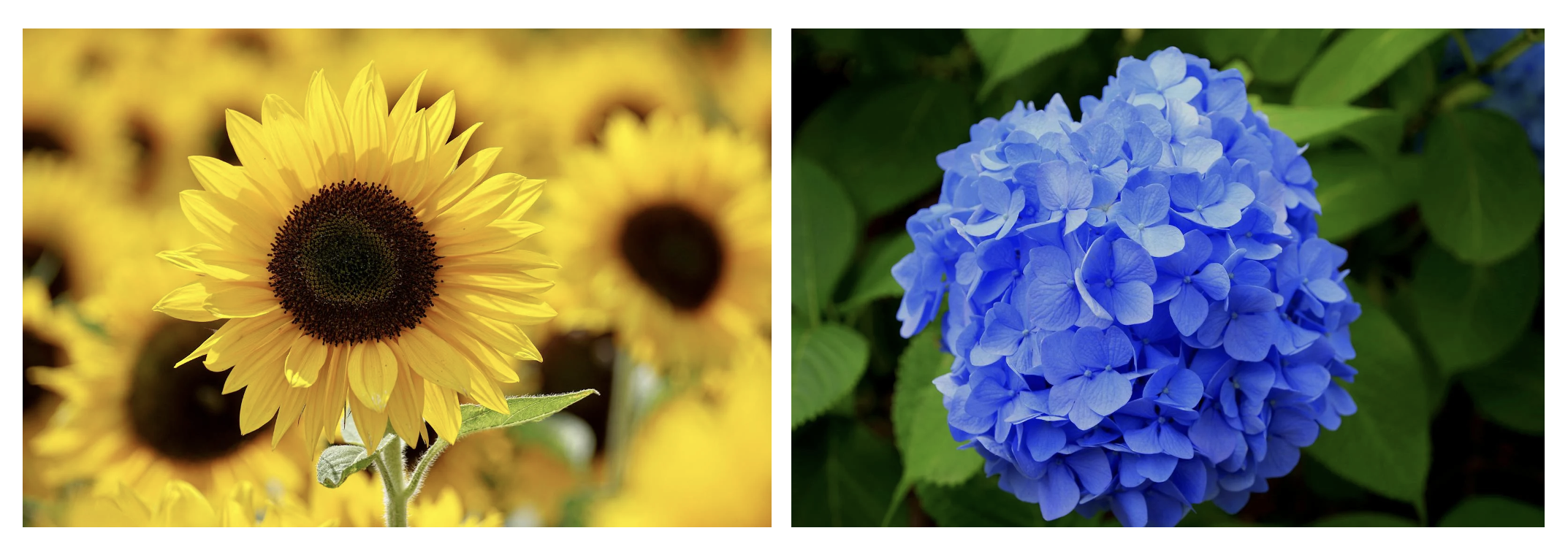

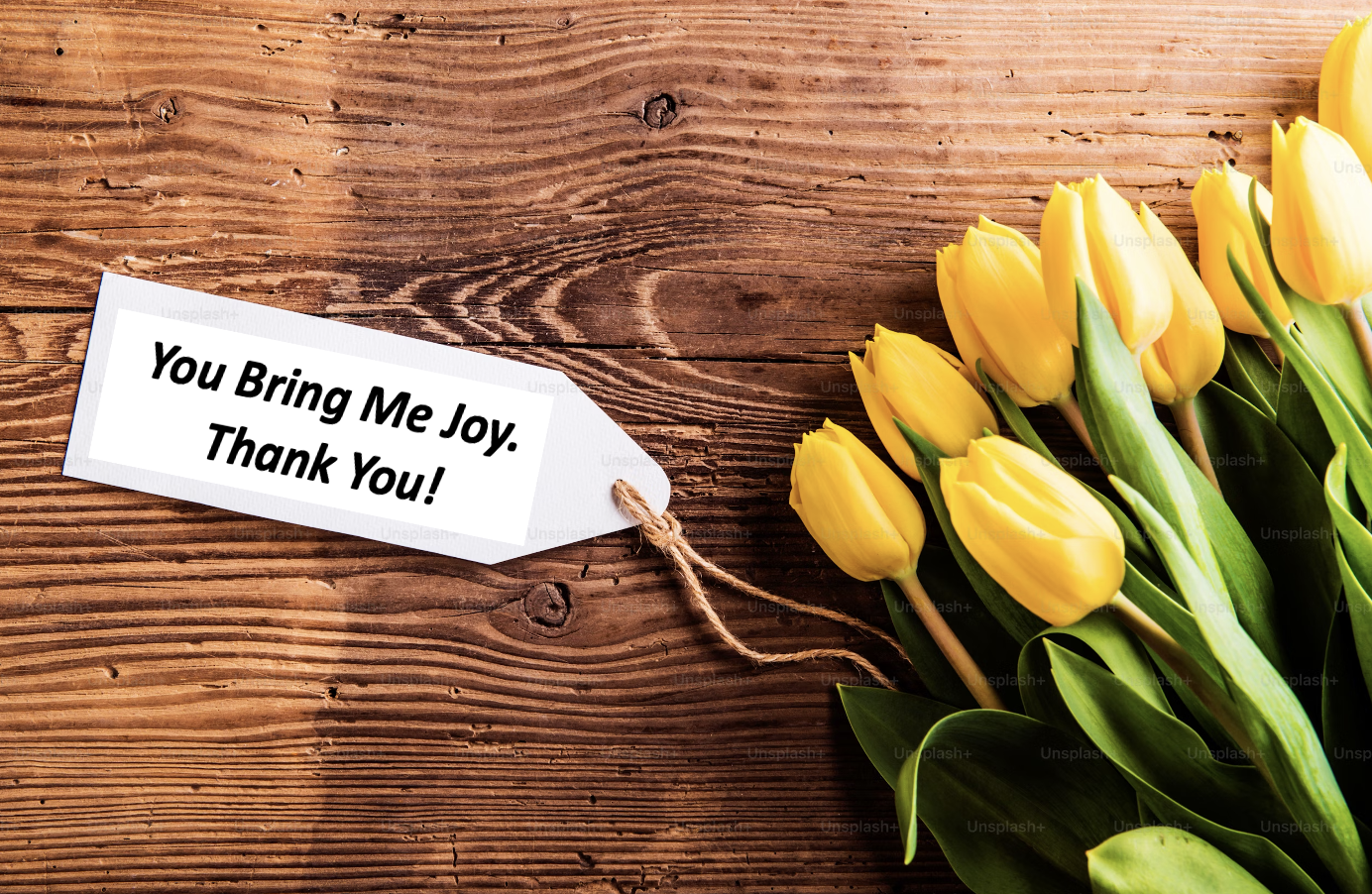 I hope you had fun reading about some of the different meanings of flowers. It was such an interesting adventure to look into the multitude of meanings that flowers can have. In past, I have always simply chosen and sent the ones in season I liked to others for special occasions, birthdays or funerals, considering primarily what flowers seemed most appropriate for a particular holiday or occasion, like Poinsettias for Christmas or Lilies for Easter. Now I suppose I can attach little meaning cards with my floral notes, like: “These yellow tulips mean you’ve brought a lot of happiness to my life.” Maybe you’ll recall one of these “floriography” flower meaning thoughts the next time you take or send someone some flowers.
 Lin Stepp