 Many people today say we need a revival in America. What is Revival? Do we understand what it means, know anything about the history of revival and of the changes a revival might bring to our lives, the lives of America’s churches, and to our nation? I thought I’d look at this term “revival” for my blog this month, do some research, and give some understandings about what a revival is and what we might expect to see in a revival.
By definition a Revival is an awakening in a church, community or nation; it is a supernatural work of God as the Spirit of God turns the hearts of a people back to Himself. Revival, throughout the ages, has been the one force that turns the tide of a declining, diminishing belief in God. A revival is needed when holy things are discredited, when people begin to love darkness more than light, when the light of truth grows dim, and when there is a general departing from the worship of God. Are we in need of revival now? Many would say “yes.”
 A new survey found that although 74% of people in America believe in God, a much smaller majority, about 25%, are affiliated with a church or religious group. This is the highest level of non-religiosity in American history, alarming for America’s churches. Within the results of this study, percentages showed that for most surveyed their idea of faith lined up very little with the principles and tenets of the Word of God. As an old evangelist once said, “They’ve got something else figured out.” Why? Most studies point to Biblical illiteracy as the primary negative issue affecting believer’s faith. Without a solid grounding in God’s Word, believers become susceptible to spiritual error and indifference, to spiritual stagnation, and moral compromise. Scott Roberts wrote: “Most church goers don’t know who God is today, and the authority of God is relativized, marginalized, or selectively interpreted to suit personal preferences or cultural norms. This erosion of biblical authority undermines the foundation of the Christian faith…This diminished understanding of God’s sovereignty, holiness, and character has profound implications for the American church’s spirituality and mission…Ours is a world in desperate need of redemption and transformation.”
 Perhaps people have tried to turn things around. Perhaps the churches have tried. But America’s faith is falling into a sad estate. In a Revival, God intervenes. “Revival is an invasion from heaven that brings a conscious awareness of God” [Stephen F. Oxford]. “Revival is when God gets so sick and tired of being misrepresented that He shows up Himself” [Leonard Ravenhill]. “Revival is a divine disruption. It is a time when God intervenes in our affairs and interrupts our activities. It is a time when God makes our comfort-zone Christianity feel uncomfortable. [Tom Palmer]. “When is revival needed? When carelessness and unconcern keep the people asleep…A revival does two things. First, it returns the Church from their backsliding and second, it causes the conversion of men and women; and it always includes the conviction of sin on the part of the Church. What a spell the devil seems to cast over the Church today!” [Billy Sunday].
Although we would love to believe we can initiate revival, and although we can and should pray and hunger for revival, it is God who brings revival, as He wills and when He wills. The Lord brings it in His love and mercy. T. S. Randal wrote: “Revival is the King of Heaven visiting His people in all His regal splendor and glory.” “Revival is the sovereign act of God in which He pours forth His Holy Spirit upon His people in a special way, whereby Christians are quickened, backsliders are restored, churches are set on fire spiritually, sinners are remarkably converted, and society is reformed” [R. B. Jones]. Isn’t that what our hearts yearn for? For God to be real and vital to us again? “Revival is God’s invasion into the lives of one or more of His people in order to awaken them for kingdom ministry” [Malcolm McDow]. “A true revival means nothing less than a revolution, casting out the spirit of worldliness, making God’s love triumph in the heart” [Andrew Murray].
 Churches often hold revivals, and we often think of a revival in those terms, as a meeting when a minister or evangelist visits in order to draw church members to a stronger place in the Lord and to lead the lost to salvation. But a true national revival is far more than this. True revival is “a sovereign, sudden, selected, sensational operation of the Spirit of God, descending in the midst of prayer, which produces purity and reaches the perishing” [Ken Connelly]. Most of us today have never experienced a true and mighty revival or experienced the mighty works of God [Judges 2:10].
Revivals are not new, even if we haven’t experienced them. We can read about revivals occurring throughout history, and Bible scholars tell us there are sixteen different revivals described in the Bible. In America two great revivals have impacted our nation. The First Great Awakening was a series of religious revivals that occurred in the American colonies in the 1730s and 1740s. Leaders prominent in this revival era were Jonathan Edwards, George Whitfield, and John Wesley. These men were fiery orators, anointed of God to turn and change the hearts of men and lead America in the direction of God’s desire. A characteristic of revivals is that the words spoken are strong ones, like these of George Whitfield: “People want to recommend themselves to God by their sincerity; they think, ‘If we do all we can, if we are but sincere, Jesus Christ will have mercy on us.’ But pray what is there in our sincerity to recommend us to God? … therefore, if you depend on your sincerity for your salvation, your sincerity will damn you.” They often strongly judged the church of their day for their weak leadership: “Congregations are lifeless because dead men preach to them.” It’s no surprise that revival ministers were seldom popular with the church hierarchy.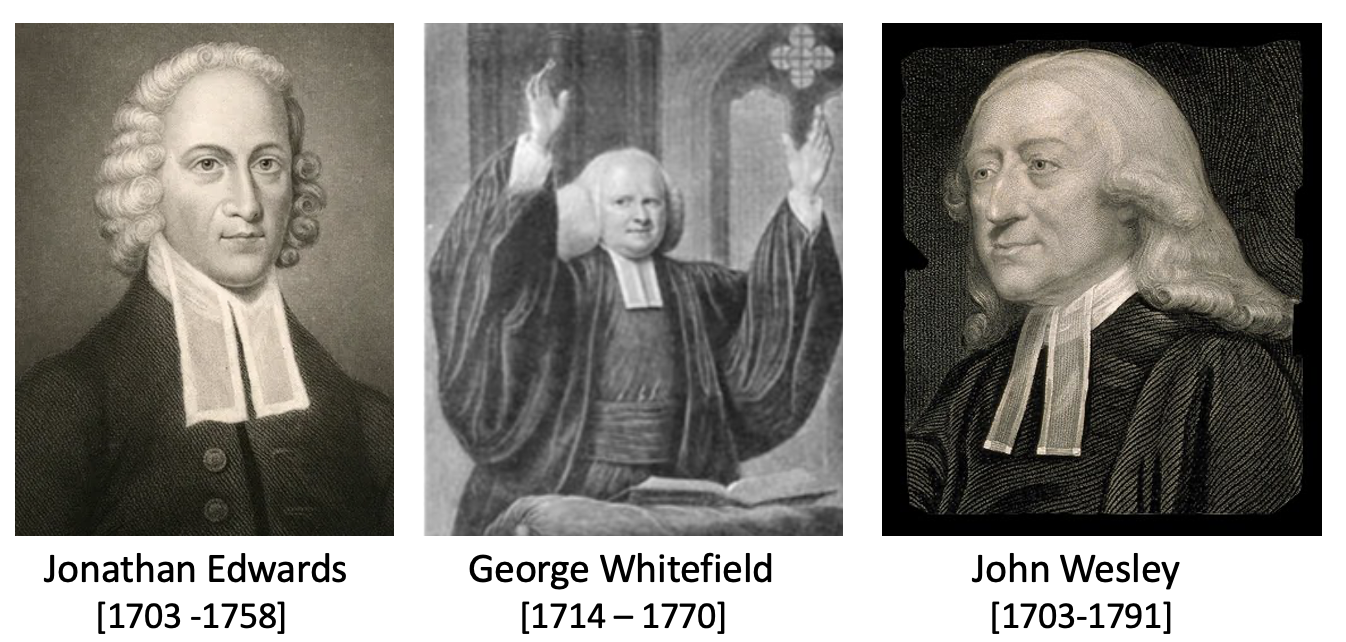
The Second Great Awakening occurred from 1790 to 1840 and on into the 1900s. During this longer awakening period, meetings were held in small towns and large cities throughout the country and the ‘camp meeting’ initiated in that period. This Awakening produced a great increase in souls won to the Lord, revival in the churches and in the establishment of many new churches. It spread religion and a deep faith in God through revival meetings and reform movements throughout the eastern U.S. and into Ohio, Indiana, Kentucky and Tennessee. Its ministers and evangelists shook the foundations of a formal, complacent church in America with impassioned and anointed preaching. This Awakening was longer and stronger than the first, and the fingers of this revival were also seen in England, Wales, and Ireland.
Leaders in this Second Great Awakening included James McGready, Charles Finney, Dwight L. Moody, Edward Everett, Hudson Taylor, John Hyde, Billy Sunday, J. Frank Norris, Jack Hyles, and others. D. L. Moody’s words reflect the message of that time: “A great many people place their faith in men, and they pin their faith to other people’s doctrines and creeds…They believe what the church believes, but they do not know what the church believes….All the churches in the world can’t save a soul. It is not to have faith in this church or that church, this doctrine or that doctrine, this man or that man, but it is to have faith in the man Christ Jesus at the right hand of God. That is the only faith that will ever save a soul.”
The revival meetings during this time were not much like the church services we sit in today. Whether in the big city meeting rooms or the camp meeting outdoor settings where they were held, the Spirit dropped down in power and might touching people in dramatic ways. The conviction of God fell on many, washing over them, filling them, dropping them to their knees, causing many to fall out on the floor under the power of the anointing of God. People were brought under conviction for their sins, their indifference to God, and responded, often with weeping and shaking, to God’s call on their hearts. Many people heard about the power and working of God in the meetings and were skeptical, but when they went to the revival meetings they saw and felt the outpouring of the Holy Spirit’s power. Sometimes over 10,000 people were converted.
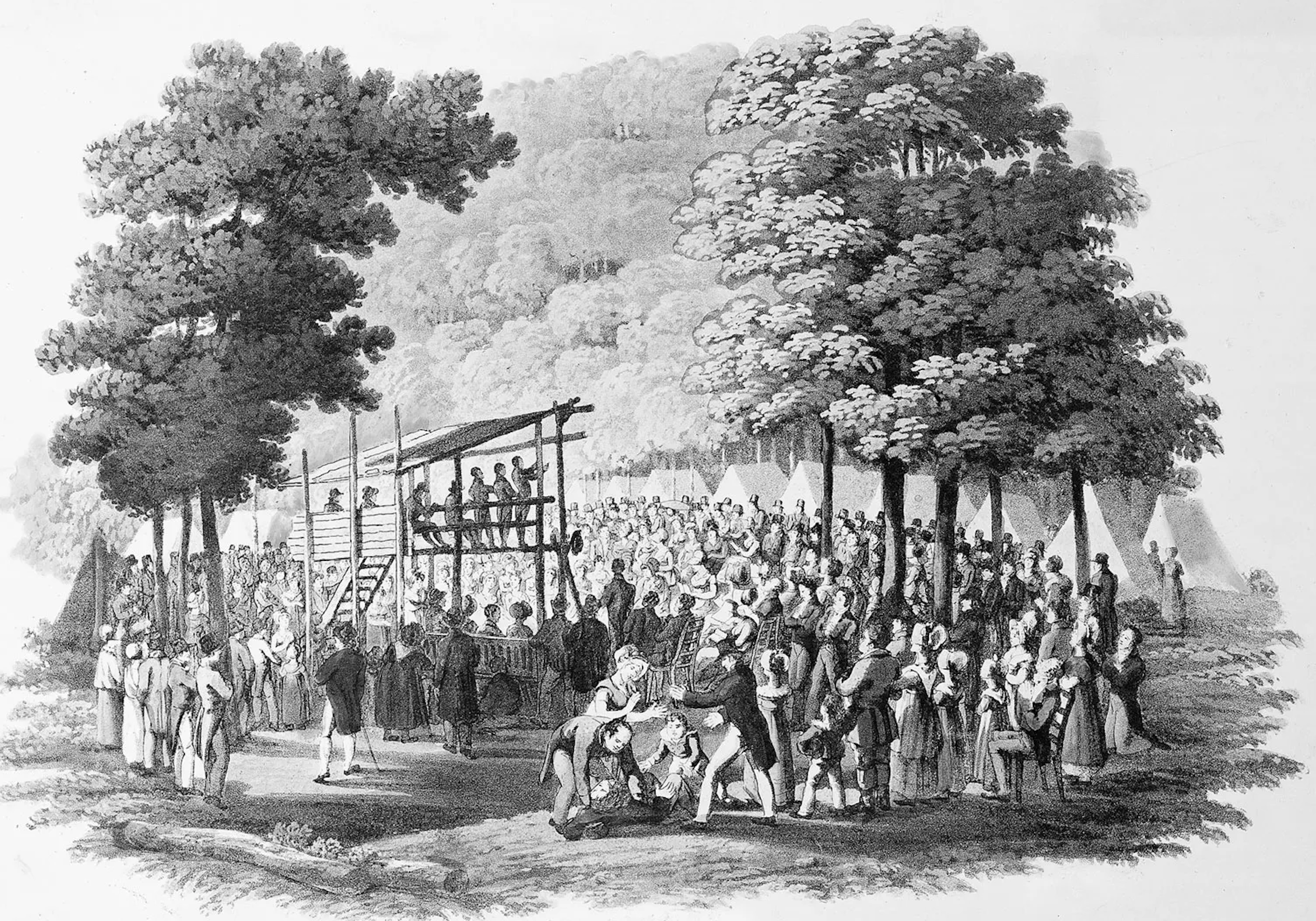 Charles Finney himself tells of going to one of these meetings, skeptical as a well-educated man and a believer, determined to stay strong and not yield to any of the “nervous excitability” he’d heard about and the fervent emotionalism. But as soon as he entered the meeting he was hit by the supernatural power that he purposed to resist. He even ran away from the spirit of God trying to impact him, but even on the route home was overcome by conviction and the emotions of his heart. He said God impacted him in such a way “people thought him deranged” and yet that converted Charles Finney went on to become a great evangelist and minister. He led revivals, led multitudes to the Lord and taught ministers. His direct, informal, and personal style offended many formal preachers of the day who felt he destroyed the dignity of the pulpit and might not appeal to the more educated in their congregations. They were soon proved wrong. Finney wrote: “Revival is a renewed conviction of sin and repentance, followed by an intense desire to live in obedience to God. It is giving up one’s will to God in deep humility…. and if the presence of God is in the church, the church will draw the world in. If the presence of God is not in the church, the world will draw the church out.” Many said Finney changed American religion. Every minister and evangelist in the Great Awakening seemed to have a different style of ministry, as led by the Lord, but each brought God to the nation.
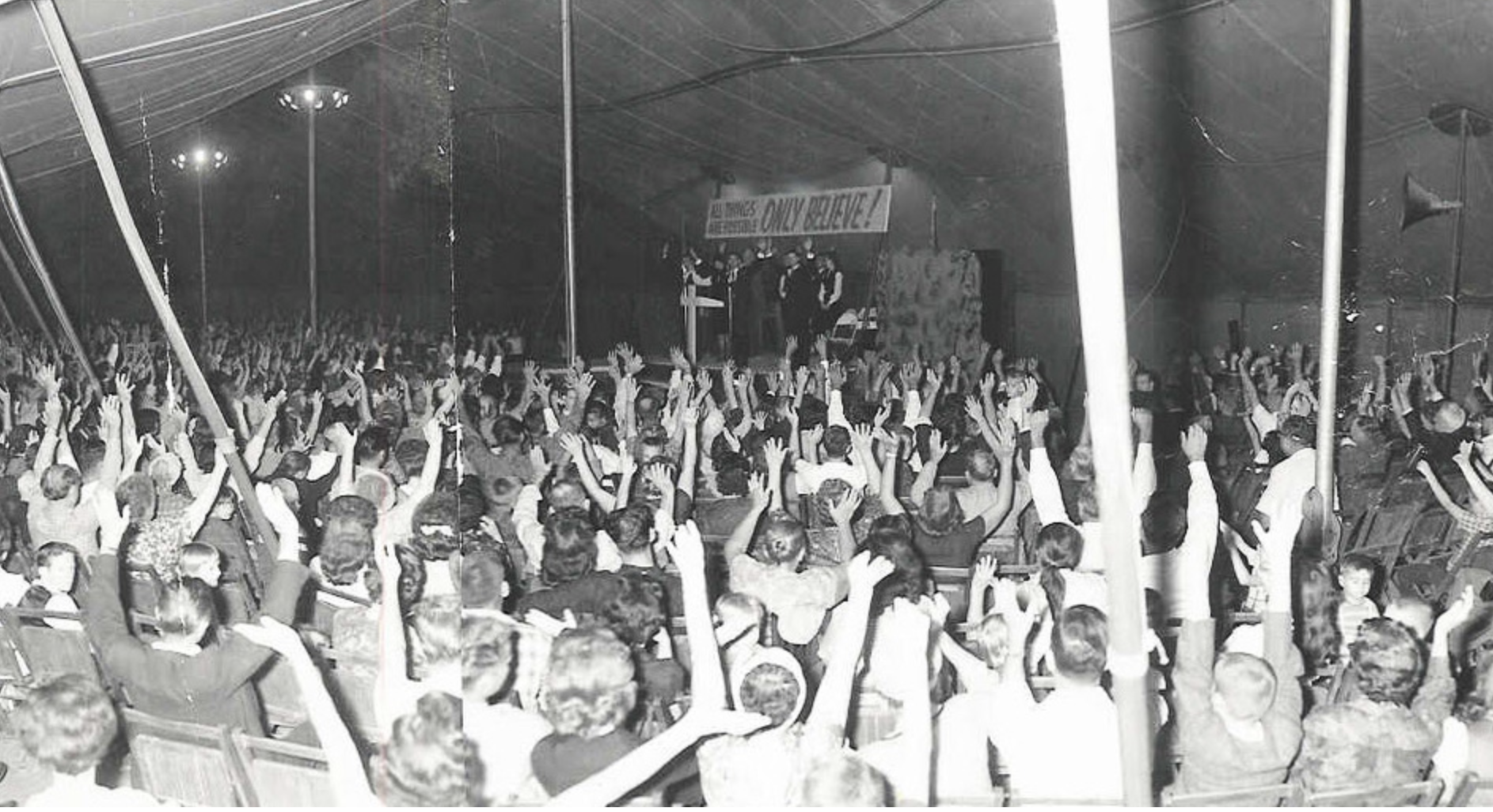 Billy Sunday was another impacted and changed by the revival meetings of the Second Great Awakening. He played baseball for the Chicago White Sox but at a big revival meeting in Chicago he got saved and left baseball to become a pastor and evangelist. God used him greatly to preach to over 100,000 people with a compelling simplicity and anointing that brought thousands to the Lord. Clergymen disliked his informal style and undoubtedly envied how God used him to bring change to so many. His sermons were filled with warmth, humor, and conviction. “The trouble with many men,” he preached, “is they have got just enough religion to make them miserable. If there is not joy in religion, you have got a leak in your religion.”…Billy Sunday often used baseball terms and actions on the stage: “The devil says I’m out, but the Lord says I’m safe.” He preached salvation in a direct way people could respond to and with the anointing on his words: “Conversion is a complete surrender to Jesus. It’s a willingness to do what He wants you to do.”
Living in Appalachia, I love the stories of the circuit rider evangelists who traveled on horseback during the Great Awakening to bring the gospel to those in the mountains and backwoods. Francis Asbury was one of those, traveling thousands of miles by horseback and carriage into the mountain frontier. He preached, held meetings, led multitudes to the Lord, and helped to start churches and schools. He rode an average of 6,000 miles each year. “True religion is the life and power of faith, and not a set of principles or a form of worship,” he wrote. He also said, “My soul is more at rest from the tempter when I am busily employed.”
Dramatic miracles, changed lives, and healings occurred regularly throughout the Second Great Awakening. Many of those things the church has decided have no place in our beliefs today showed up regularly in the revival meetings. A young woman crippled from childhood, was completely healed in one meeting, with healing and deliverance miracles reported often. Even John Wesley’s own brother Charles experienced deliverance from a lung inflammation during a meeting. Animated singing, mighty moves of God’s spirit and power, weeping, and testimonies filled every service. James McGready wrote of one of his meetings: “The mighty power of God came amongst us like a shower from the everlasting hills –God’s people were quickened and comforted: yea, some of them were filled with joy unspeakable and full of glory…many fell to the ground, lay powerless, groaning, praying and crying for mercy …precious souls were brought to feel the pardoning love of Jesus.”
 People didn’t even want to go home and stayed on and on, not wanting to leave the anointing at these sites. A presbyterian pastor wrote: “No person seemed to wish to go home—hunger and sleep seemed to affect nobody—eternal things were the best concern… Sober professors, who had been communicants for many years, now lay prostrate on the ground crying out.” What incredible stories. How long has it been since you’ve been in a service so anointed that you didn’t want to leave, forgot to look at your watch?
I loved reading the miracle stories from the Great Awakening. In the brush arbor revivals, people came from long distances, setting up tents and sheds, and brush arbors for preaching platforms. The people often stayed for a week or more, hearing preaching every day. At one Kentucky meeting like this, a huge storm was moving in. The people knew it would end the meeting and possibly tear down the arbors and stages erected, so they all began to pray fervently for the storm to pass them by. As the huge storm, with its wind, rain, lightning, and thunder grew near, it suddenly separated, moving over and around the revival area entirely and then passing on. I imagine a lot of rejoicing happened then! … In Wales, the spirit of God moved into a small town one night, shaking plates and dishes on the walls of homes and causing the people to run out into the streets in the dark in their nightclothes, dropping to the ground on their knees under conviction…. I read, too, that when the Spirit of God was moving strongly in New York, that when the big ships came into the harbor, the Spirit swept over the boat, causing those onboard ship to fall to their knees under the anointing and conviction of God.
 This was a time when people had given up on miracles, when many no longer believed in God or the power of God, and yet God showed men and women in this time who He was. If He did this again in another mighty revival, would you be a scoffer or a believer? Would you be open and eager to embrace all that God might do, or distance yourself from any revival meetings, fearful that your beliefs might be challenged? The Bible says ‘If we are faithless, He remains true and faithful to His Word, for He cannot deny himself.” [II Timothy 2:13]
Some people are a little reluctant to come under the conviction and power of God. But in a revival, God does what He will, not what we decide. He shows us all the ways our God is too small, our faith too narrow and limited. Tim Keller wrote: “Revival isn’t something human beings do… real revival is the intensification of the ordinary operations of the Holy Spirit. When the Holy Spirit begins to do His work, He brings repentance and assurance … it wakes up sleepy Christians.”
 Revivals bring good, needed change. They blow new life into Christians individually and into the church. Henry Blackaby wrote: “Revival is a divinely initiated work in which God’s people pray, repent of their sins, and return to holy, Spirit-filled, obedient, loving relationship with God.”
Some people say revivals don’t last, but they do have long-lasting results. There are many lasting results of true, God-anointed revivals. Thousands are brought to know the Lord in revival. Churches are changed and church leaders are renewed. There is a change in the moral fiber of a nation and in the communities where a revival flourishes. A heart for missions and change grows out of the roots of revivals. The Great Awakening led to many social movements, like the Haystack Movement, the American Bible Society, The Salvation Army, the YMCA, greater women’s rights, prison reform, the Temperance Movement, and many other mission movements.
Revivals bring a change to worship from the very formal, ritualistic pattern to a freer, more evangelical state, where God’s Spirit can move and work. Revivals beautify the church, recover the gospel, bring back the anointing and the sense of God’s presence in every service. “Revival is a divinely initiated work in which God’s people pray, repent of their sin, and return to a holy, Spirit-filled, obedient, loving relationship with God” [Henry Blackaby]… “Revival is a time of renewed spiritual health brought about by the touch of God” [Philip A. Jones]. And surely we all need that. Perhaps we should all pray, Lord, ‘revive us again’ like the old hymn. Revive us according to your ways and your loving kindness [Ps 119:37; 88] “An old-fashioned revival is the medicine for these times” [E. M. Bounds].
______________________________________________________________________________________
Note: All photos my own, from royalty free sites, or used only as a part of my author repurposed storyboards shown only for educational and illustrative purposes, acc to the Fair Use Copyright law, Section 107 of the Copyright Act.
 Lin Stepp
I loved this article, Lyn. We so desperately need another Revival in this nation, even the world. The United States is suffering from a lack of wisdom, and the truth in the Bible. Our is constantly talking about how much a revival would right many wrongs in this world. Even persons who are struggling like my children.
This email is being forwarded to my husband so he can experience these wonderful facts. He loves to delve into history of any kind, but most of all Christianity. His Bible is well read as he reads it everyday.
May GOD bless you and your husband. Enjoy the Smokies for me as I miss them so much, particularly during the fall season.
Judy Sexton
LikeLike
Thanks Judy … So glad if you enjoyed this article.
LikeLike
Thanks for your note …Good words. May God bless you both, too!
LikeLike