 I live in the city of Knoxville, Tennessee, a short distance from the Smoky Mountains. In my part of the world, we experience the four seasons… a warm but pleasant summer, a pretty, colorful fall, a cold and sometimes snowy winter, and a lovely spring, rich with flowers and new growth. “Hurricane” is a word we’ve heard often enough here in Tennessee and my Appalachian area, but generally to our way of thinking it relates to the coastal areas of the United States. When those harsh tropical storms blow into the panhandle or up the east coast areas of the southeast United States, we watch the reports, remembering those we know and love who live in those areas that might be affected, praying for them, checking on them. Sometimes as the rains and winds from hurricanes and tropical storms blow inland, we get a lot more wind and rain than normal, occasionally flooding, Sometimes, trees are felled by wind or too much rain in the soil. But we rarely if ever see any really destructive weather damage.
 In the past. Knoxville and East Tennessee has received a little wollop from Hurricanes like Hugo, Opal, Frances, and Ivan that packed enough wind to topple trees and power lines. Sometimes low-lying roads and trails in the valley here around Knoxville and in the Smokies get flooded and the roads closed, but Hurricane Helene sent our region a sweep of frightening damage and destruction most of us, even those of us who grew up here like me, have never seen before.
 As Hurricane Helene moved closer to the gulf coast and the Panhandle last week, the reports began to predict that the cone, and the storm, would roll up through the southeast, bringing us a lot of rain and wind. It was Florida though and some of lower Georgia that were told to prepare, to batten down the hatches, to possibly evacuate in especially vulnerable areas. Most of us around the Appalachian area, so much further north, didn’t even race out to the store to get bread, milk, and some groceries, to get extra water, to fill the bathtub, to make preparations for possible power outs or problems as with the occasional winter snowstorms we get.
 Hurricane Helene streaked into the coast, a large, fierce storm, but soon downgraded as it began to move inland, except that the storm was wide and filled with ongoing rain and wind, especially heavy, heavy rain. It had actually been raining somewhat heavily around many Appalachian areas of Tennessee, North Carolina, Georgia, and South Carolina a couple of days before Helene even moved in, which didn’t help things as Helene’s rains progressed our way and it rained and rained, and then rained and rained some more. Swollen rivers began to overflow their banks. Flood reports began to come in from many areas. And the ongoing rains didn’t stop. In many areas felled trees and flooding began to create power outages, storm damage, and unexpected worries. Those unexpected problems escalated as Helene began to linger on and on over our area.
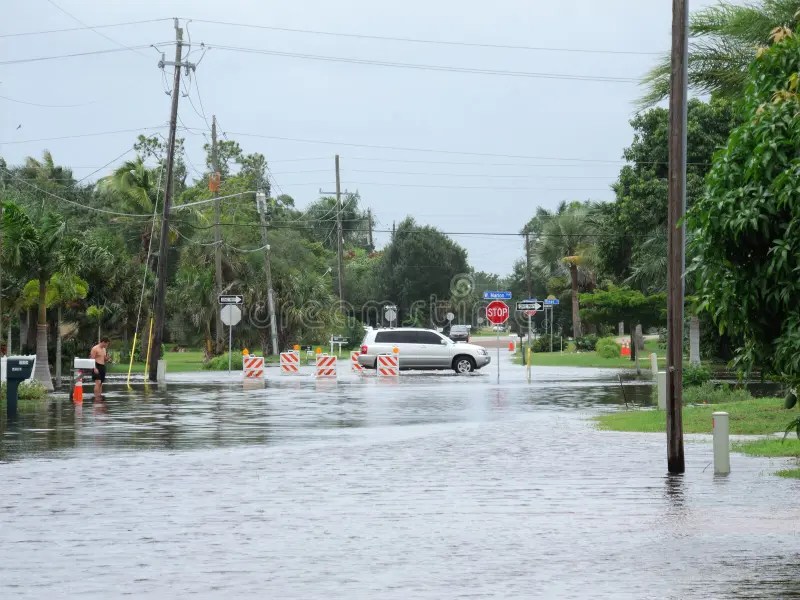 We began to hear reports that conditions were really bad in many areas, that roads were closed, farmlands and homes inundated with water, and even towns along the rivers flooding and the waters raging. People were stupefied. It was so unexpected, and much of it came more rapidly than anyone envisioned, too. Evacuations began as the turbulent floodwaters crept into businesses, people’s homes, and over more and more of the towns and lands around the Tennessee and North Carolina mountain areas, all so familiar to us. Festivals in the Smokies—like one where we were scheduled to sign books—cancelled, businesses shut their doors, roads were closing because they’d become impassable. People began to be warned of more imminent danger to come, too, from the ongoing rain, floodwaters, felled trees, and more.
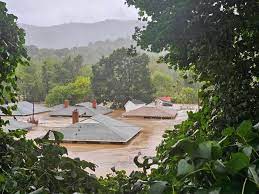
 Many of us, like J.L. and I were stunned and shocked, as footage began to show up on internet sites, Facebook, and the news channels of whole towns being flooded, roads being washed away, homes underwater to their roofs. We simply don’t see sights like these in our region and it was hard to look at the images and realize how close to our home they were. Farmers began to see their entire fields, barns and outbuildings being covered with water, often too swiftly and unexpectedly to get their equipment and animals out safely. What had been predicted to be a heavy storm quickly turned into a nightmare.
 By Saturday, more and more unprecedented catastrophes were being recorded. Here in our part of Knoxville, we were blessedly safe, the rains dissipating some, everything soggy but with little damage reported near us. But almost every road in the Smoky Mountains closed and streams and rivers there had turned into a torrent, flooding over walls into the streets of Gatlinburg and Sevierville, flooding side roads and hiking trails, washing out sections of the Appalachian Trail. Signs were posted asking people not to come to the Smokies at all and soon we began to learn the flooding and problems there were larger than we knew.
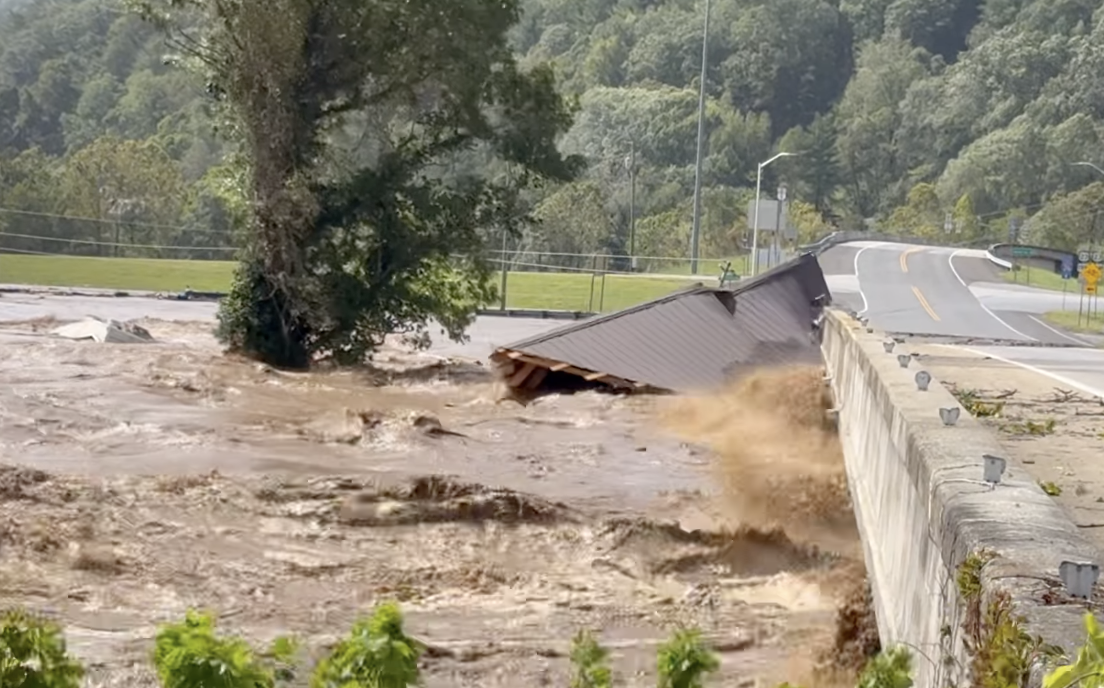 Western North Carolina especially got pummeled with Hurricane Helene. Flooding seemed to be everywhere. Trees felled in many areas, and power outages increased. Large sections of towns along streams and rivers like Waynesville, Sylva, and Asheville were soon awash in flood waters. Towns, large and small, like Hartford and Hot Springs between Tennessee and North Carolina, were soon flooded, streets torn away by the water, buildings collapsing and rolling downstream. In Erwin and Unicoi County, in the Tri-Cities area of East Tennessee, the Nolichucky River went crazy, breaching its banks and turning into a wild rampaging river, grabbing homes and barns in its teeth and swirling them downriver to crash them into bridges. Buildings were soon submerged in floodwaters. Fifty-four people were stranded on the Unicoi County Hospital roof and efforts to rescue them by boat and helicopter failed. They spent seven hours in fear on the roof watching the roaring flood waters all around before they could finally be rescued.
 Area dams in these areas were pushed to capacity, with water cresting over the dams and flowing around the sides of the dams. A number of flash flood warnings were put out that dams were close to imminent failure and affected residents warned to evacuate like at the Nolichucky Dam. The Waterville Dam, just over the state line in North Carolina, sent out warnings, too, as did the Lake Lure Dam in Rutherford County, North Carolina. Other dams around the TN and NC area began to send water spilling through all their gates, because of the critical need to handle the water buildups, but this brought flooding to many areas along the rivers below.
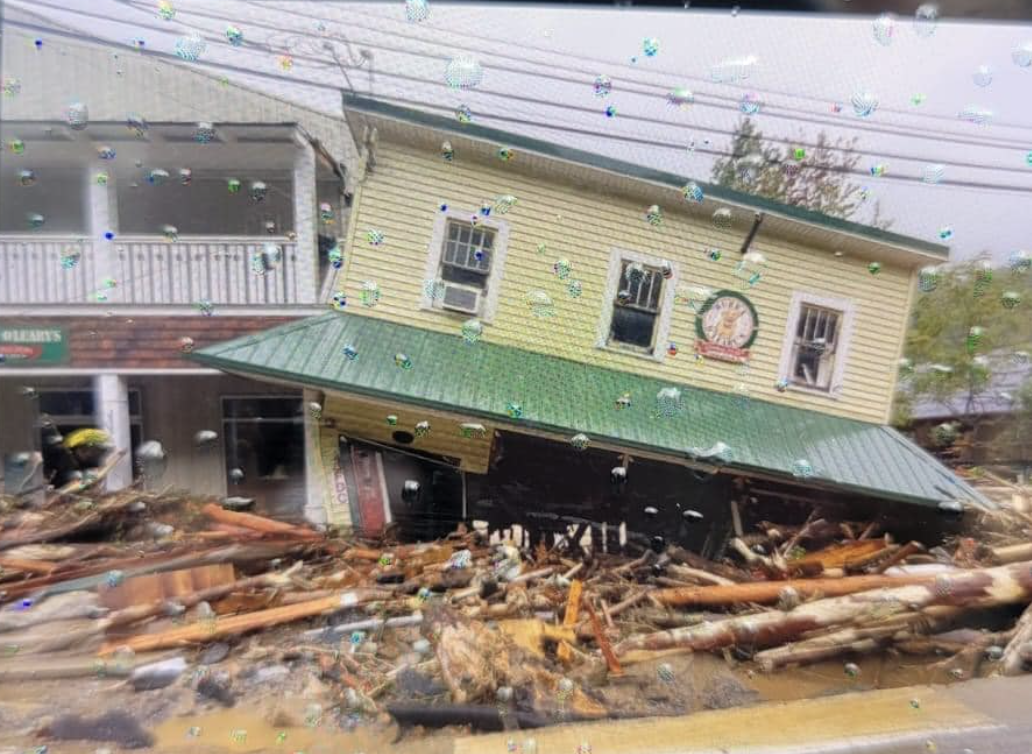 The dams held, blessedly, but the waters rushing down the river and the streams continued to bring more and more damage and chaos. The small tourist town of Chimney Rock was completely destroyed by the flooding, the town a rubble of ruined buildings with roads torn apart, trees felled, and bridges destroyed. The pictures were heartbreaking to see. Water roared through the main roads of Maggie Valley and flooded nearby Waynesville, North Carolina. The town of Asheville was soon flooding in many areas, too, like around Tunnel Road, and the historic Biltmore Village was soon almost submerged with flood waters from the Swannanoa River. The waters also flooded the town of Marshall and other nearby areas. The floodings spread down to Hendersonville and into South Carolina towns like Greenville and Spartanburg. People began to be trapped on rooftops and in upper stories of homes and buildings. Mud and rain filled the roads with power-outages everywhere. Deaths were being reported, not only in Florida where Hurricane Helene first hit, but in Georgia, South Carolina, into North Carolina, and Tennessee.
 On Saturday, a huge section of Interstate 40 between Tennessee and North Carolina, heading toward Asheville, totally collapsed, closing the interstate. Soon other major roads were closed, like I-26 not far from Johnson City, where whole sections washed out from flooding. Continuing road closures soon left Asheville virtually stranded with no safe way to come or go and with much of the city without power, cell service, or safe water. It was incredible to see this major city brought nearly to a standstill with rescue operations continuing all around the city and the nearby North Carolina area.
 I saw videos of farmers weeping over their horses and animals lost, of their crops destroyed. Having just traveled all through Georgia, I saw, as one farmer said, the cotton and peanut crops ready to harvest, and remember the huge tracts of pecan groves, many now destroyed. Dairy farmers who use machines, now with power out, can’t milk the cows and they are suffering, and the farmers sorrows and losses will impact the availability and prices in our grocery stores to come. This makes me realize how much more a part of each other we are than we realize.
 Life so often brings us surprises we don’t expect, too. We often think we have control over our lives and our world but then find we do not. Life, instead, is full of unexpected twists and turns. We have to all become resilient in this life, able to stand through those dark and unexpected times, to be strong enough to survive and overcome the unexpected. I am a person of great faith and believe strongly in the protection of God and in the power of prayer. But as Julius Caesar wrote, “No one is so brave that he is not disturbed by something unexpected.” And these unexpected tragedies in our Appalachian area of the world have certainly been that.
 How do we handle the sorrows, the unexpected tragedies of life? How we do handle them tells a lot about who we are. Some suggest that it is when the going gets tough that our character is revealed. William Samuel Johnson wrote: “He knows not his own strength who hath not met adversity.” I also like this quote by Doe Zantamata: “It is only in our darkest hours that we may discover the true strength of the brilliant light within ourselves than can never, ever, be dimmed.” I hope that light in you is faith, and that in all situations of unexpected sorrow, tragedy, or calamity that you draw strength from the Lord and gain help from Him, knowing God is always ‘your refuge and strength,’ like Psalm 46 promises, ‘a very present help in trouble, and that though the earth be removed, the mountains be carried into the sea, and though the waters roar and are troubled and the mountains shake, He will be there.’
What is your response to the troubles of others? As you would want help in trouble, not just from God, but from the people around you, you should try to be a help, too. In times when you learn of calamity, suffering, and unexpected and harsh events that shake people’s worlds, find a way to be there for them as you’d want them to be reach out to you. Love your neighbor as yourself.
 Perhaps you have been grieved and shocked over the devastation from Hurricane Helene. Undoubtedly, you have watched the news in distress and seen the painful photos of the destruction. Concern is good and prayer is good, and we should all be praying and concerned for those in hurt and need, but we should also reach out and “give” tangibly. Research, pray, and seek for a route to give money and help in some way, through a reputable helping source you know of that will get help directly to those in need. Look for one that is already reaching out to take in supplies, aid, water, and food and be wary of scammers or organizations that keep the major portions of funds received within their organizational structure. Search, pray and ask God “What can I do?” If you know anyone personally that is suffering want or need or loss, then reach out directly to be a help. As Proverbs 3:27 advises, don’t ‘withhold help when it is in your hand to do good to those in need.’ Be a giver; find a way to freely give. In all areas of your life, not just in a calamity, look for ways to give back for all the blessings you enjoy. And “When you arise in the morning, think of what a precious privilege it is to be alive—to breathe, to think, to enjoy, to love” [Marcus Aurelius]. We have so much to be grateful for every day that we so often take for granted.
______________________________________________________________________________________
Note: All photos my own, from royalty free sites, or used only as a part of my author repurposed storyboards shown only for educational and illustrative purposes, acc to the Fair Use Copyright law, Section 107 of the Copyright Act.
 Lin Stepp
Thank you for writing a well thought informative post. I live in southern North Carolina so I was minimally affected by the hurricane. The devastation to Western North Carolina is like nothing we ever imagined could ever happen, but it did. I have family and friends in the impacted areas from Asheville on up through Blowing Rock, Boone, West Jefferson and on up. Many still without power, still stranded and struggling. I feel their losses.
LikeLike
Yes … and I wanted to write about it when so many said, “What? A hurricane in the mountains?” It’s truly been a sorrow to so many.
LikeLiked by 1 person
I know it has, I have cousins that have been affected and struggling. I feel for all those affected and I know their losses are devastating.
LikeLike
So many people have known such great loss … and here into the cold of December, so many still have no homes, no electricity, or even running water. My heart goes out to them.
LikeLiked by 1 person