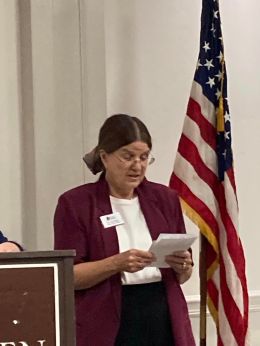
 This month for my May Blog, I wanted to share the essay I submitted this winter for the National Society Daughters of the American Revolution annual DAR Women’s Issues contest. We were to write our essay in one of four categories: Career, Family, Mental Health, or Physical Health. I submitted my essay in the Careers category and I recently learned that my entry won 1st Place in Tennessee and 3rd Place in the Southeastern Divisional level. This lovely certificate, below, was given to our chapter regent this month at the State Conference in Nashville. I was unable to attend, since I was traveling in South Carolina on Book Tour, but I am pleased for the first place award for our chapter and for the third place recognition at the divisional level for the Tennessee State Society as well.
 I give the main credit for this nice honor to our Chapter Regent Brenda Wyatt who kept pushing me to take time to enter. I started to write the words “badgered me to enter” in humor. I was so busy with work at that time, in edits for one book and working on writing another, that it seemed hard to imagine I could find the time for anything else. But I stopped to plan and write the essay, with Brenda’s urging, on a careers subject dear to me – that it is never too late to follow the dreams in your heart. I titled it: “BE ALL YOU CAN BE, NO MATTER YOUR AGE.”

If you’re unfamiliar with the DAR, it is a lineage-based service organization for women who can prove descent from a patriot of the American Revolution. More than one million women have joined the DAR since it was formed over 125 years ago and today there are about 185,000 members nationwide in 3,000 chapters in all fifty states of the U.S. – most chapters named for patriots.
 I belong to a Knoxville, TN, Chapter called Andrew Bogle DAR and I have been in the DAR since college years before marriage. I have carried a lot of offices and roles over the years with DAR and I am currently our chapter’s Chaplain. Ours is a large, friendly, active group, and If you are interested in DAR and would like to learn more about joining our Andrew Bogle Chapter, please feel free to contact our Chapter Regent, Brenda Wyatt, at her email at: wyattb6673@gmail.com …
 As an additional treat this month, I also received a Recognition Certificate of Award for “FIFTY YEARS OF SERVICE TO DAR.” Below is the brief DAR essay that I hope you will enjoy reading … and I also hope, like the title, that it will encourage you to be all you can be and to follow your dreams, no matter your age!
Essay Title: Be All You Can Be, No Matter Your Age
By Dr. Lin Stepp
One of my favorite quotes, posted near my computer is: “It’s never too late to be what you might have been.” I first read these words, in a book by Shad Helmstetter, when trying to rally the courage to step out and pursue a new career goal at what many would term “mid-life” or “over-the-hill.”
 Despite all the progress women have gained, in attaining equal rights to reach for higher achievement at any age, women are still marginalized and limited in reaching for their dreams by many factors—the culture, the expectations of others, gender and ageism stereotypes, and a deep, innate desire to please others that often holds women back from boldly pursuing their goals. Women, in particular, seem to want someone to give them permission to step out courageously to strive for new goals, and yet it is rare that the encouragement they yearn for will come.
This is particularly true for woman at middle age or older, who are even more settled in their lives, and more fearful, of all that might be involved in pursuing a big life change. They say, all too often: “I’m too old “… “It’s too late … and “What will people think?” For many women, often with home responsibilities, another ongoing job or career, and a wealth of social activities and involvements in club and civic organizations, they often sluff off the very idea of pursuing any new dream, goal, or career, seeing themselves as simply too busy.
 I speak for many groups and organizations, and I have encouraged the women and men in them, and the many college students I have taught as a professor, that it is never too late for them to pursue the dreams of their heart, no matter their age, the environment they grew up in, or if anyone is encouraging them or cheering them on. Ultimately, the courage to pursue any dream must come from within, and particularly in middle and older age, each of us will either step forward into growth every day or step back into safety and the comfortable, familiar habits and life patterns we are used to.
I met all these obstacles and challenges at mid-life when I started back to college to get my doctorate degree. My children were still at home in middle and high school. In the early 1990s then, our family had been through some difficult financial hardships, too, with a business shutting down my husband worked in. I was working in educational sales, traveling a lot, and the timing to “feel led” to go back to college, even on the side, seemed impractical to most.
 Additionally, taking any debt to attend school, with my own children’s college years not far ahead, wasn’t an option, so I picked up a second job to pay for my college expenses. On a somewhat humorous note, the doctoral program I was entering, in Educational Leadership at the University of Tennessee (UT), would have been an impossibility for me at all as a young girl. Women were not allowed to even apply for that doctorate program then. When I started my studies, those old stigmas still circled among faculty in the college. One of the best encouragements I received in those years came from an unexpected source, from a UPS delivery man who said wisely: “Give it all you’ve got. It can never hurt to better yourself.”
Those years were challenging, attending college classes around home, work, and family responsibilities, but I thrived on the new learning I was gaining and found it rewarding and meaningful. I made the Dean’s List in my grades and was awarded the Ralph F. Quarles Scholarship in 1995 for leadership potential and academic performance. The funding helped me let my outside job go to focus more on my studies, and the next year I also attained an appointment as a Graduate Assistant at the College of Education, which I carried until I graduated. My graduation day was particularly sweet as I graduated with my doctorate, with honors, on the same day my son graduated with honors in his undergraduate program.
 After graduation, I began teaching college courses at Tusculum College where I continued working and teaching for twenty years. I taught a wide variety of Psychology and Research courses in the college’s Adult Studies program, where I worked with young and older adults, most returning to school to get their education while working and raising families. It was a joy to learn, along with my students, and to encourage them in their lives as individuals. I still keep up with many of my old students and those years were filled with rich meaning.
In the early 2000s, with our children finally grown and gone from home, my husband J.L. and I began to hike in the Smoky Mountains. We’d bought a variety of hiking guidebooks, but found them geared more to hardy, Sierra-club types than to us. They often labeled hikes easy that we considered hard as middle-aged hikers, only hiking on the weekend. Many gave poor directions and didn’t describe the trails as accurately as we’d like either. I had been journaling many of our trail hikes and J.L. had been taking photos, so we decided to write our own hiking guide. We began working on it with joy and zeal around our full-time jobs.
 I was teaching then and also working part-time as the Educational Coordinator for Huntington Learning Center, traveling to visit schools in four counties. Many of our friends, of similar ages, were retiring, but we were moving into new ventures. In truth, most people didn’t have any confidence that we could write a book or ever get it published. Their comments were polite and somewhat condescending. Frankly, it was the type of encouragement I was used to, and I had learned well from experience in past, as C. S. Lewis wrote, that: “You are never too old to set a new goal or dream a new dream.”
As an avid reader, while we traveled around to hike trails in the Smoky Mountains of Tennessee and North Carolina for our book, I began to yearn to read novels set there, too. I stopped into bookshops and stores on our travels, looking for the kind of book I wanted to read, but couldn’t find any. Most were set in the past about early settlers, moonshine recipes, or mushrooms. I often asked: “Don’t you have any contemporary novels set in the mountains with a little romance, suspense, and a rich, good story?” One of the store managers one day said, “Ma’am I, wish I did. People ask for them all the time. You’d think with the Smoky Mountains the most visited park in America that someone would write some.”
 I suppose that seeded the idea, and one day driving back from speaking at a school in Vonore, Tennessee, the idea for a series of novels—just like I wanted to read—rolled into my thoughts. Long years ago, as a young girl, my dream had been to write books, so I thought: “Why not now?” I went home and began plotting out a series of novels I called The Smoky Mountain series, contemporary romances, with a dash of suspense, and a touch of inspiration, each one set in a new location around the Smoky Mountains.
The next challenge was finding time to write these books around my two jobs, teaching at Tusculum and marketing for Huntington. Determined, I sat down and plotted out a schedule for my writing. For years I’d taught my students that most people live far below their potential, that nothing is too high to reach for and work for, so now I had to practice what I’d taught to reach for the new career dream that called to me. In 2007, when my daughter was home for a Christmas holiday, she said, “Mother, you need to find a publisher for these books. They’re wonderful; you need to share them with others besides us.” I had three written at that point and was working on a fourth.
 I faced a new learning curve in figuring out how to seek publication for a book. However, in 2008 I signed contract with a big regional publisher in Winston-Salem, North Carolina, to publish my books. To say that everyone who knew me was stunned would be an understatement. Next, I faced the huge, daunting new task of marketing and traveling to sign and speak about my books, while continuing to write more books and also work. After the publication of five novels and our hiking guide, I had to pursue a new publisher, as well, due to changes with my current one. I was blessed to sign with Kensington Publishing for my next titles, one of New York’s huge, national publishers. My books had been selling well before, but now I began to experience the blessings of hitting the New York Times, USA Today, Publishers Weekly, and Amazon Bestseller lists, and my titles began to publish internationally as well as in the United States.
In quick update, I now have twenty-seven published book titles, with two more scheduled to release this year. I retired from my work with Huntington along the way and from teaching at Tusculum a little later. I am now a full-time career author. I keep up a huge writing and signing schedule, traveling to about fifty events a year and writing two novels a year. Additionally, my husband and I have continued to travel and create more guidebooks, after our hiking guide was such a success. We now have three published state parks guidebooks for Tennessee, South Carolina, and North Carolina, and hope to begin another soon. J.L. and I also published a jointly written 365-day devotional guide.
 I thank God every day for enabling me to have enjoyed a whole new career in my middle years. It truly is never too late to be what you might have been in this life, if you will believe in yourself and your dreams and work hard to see them come to pass. One of my greatest joys now is in encouraging other men and women to pursue their dreams, and to overcome all the roadblocks and challenges along the way, to see their dreams become a reality, too.
…Look for my May Newsletter, too, at: https://linstepp.com/media-2/
Note: All photos my own, from royalty free sites, or used only as a part of my author repurposed storyboards shown only for educational and illustrative purposes, acc to the Fair Use Copyright law, Section 107 of the Copyright Act.
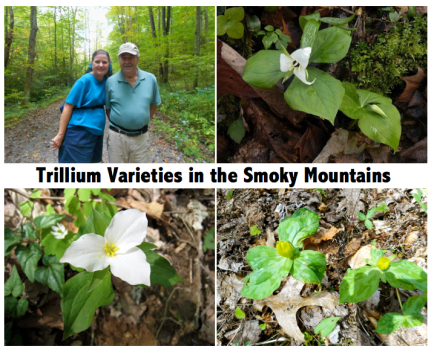 Living near the Great Smoky Mountains, I look forward to the wildflowers blooming every year. When J.L. and I were working on our hiking guidebook, we were on the trails often through all seasons, always seeing new flowers along the way. But April was always the prettiest month of the year for enjoying the wildflowers. It’s also in April when the wildflower pilgrimages and wildflower walks around the mountain areas are held. There are more than 1,500 kinds of flowering plants in the Smokies, more than in any other national park, so there are always many varieties and types of wildflowers to discover.
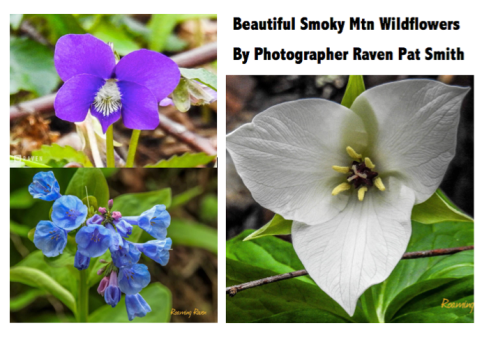 On our hikes and walks in the mountains, we have taken many photos of wildflowers, like the photo of us at the beginning of this post with several varieties of trillium, an early Smokies wildflower. However photographer fans and friends of ours, that we’ve met on the “writer’s road,” take far more spectacular and beautiful photos than we do, so I’ve spotlighted some of their work in this blog post. Raven Pat Smith’s photos above show a glorious white trillium, an early purple violet and wild bluebells.
 We often discover daffodils, flowering shrubs, and non-native plants around the crumbling walls, foundations, and chimneys of old homesteads—the flowers living on long after the people and farms are gone. Marie Burchett Merritt’s photos on the right show dogwoods in bloom, yellow trillium, and wild dwarf iris—that I always love spotting on the trail.

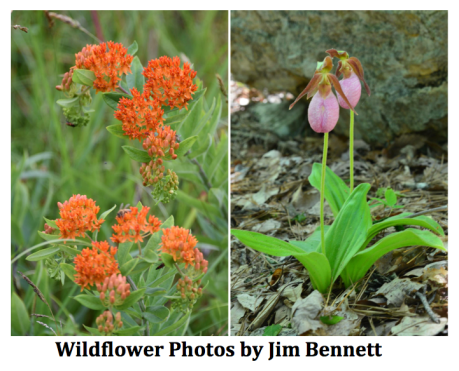
 Vibrant pink Catawba rhododendron, like in Kristina Plaas’s photo, grow in the higher elevations like on Andrews Bald or near the Chimney Tops Trailhead. Many wildflowers we simply run into along a trail … stopping to delight in our “finds.” Special wildflowers, always a treat to discover, are white dutchman’s britches, yellow lady’s slippers, and red Indian paintbrush, also in Kristina Plaas’s photo above.
 We tried to mention in our hiking guide The Afternoon Hiker trails especially known for wildflowers but flowers in the mountains often show up in unexpected places, and there are flowers of different types to see from early spring into the late fall. But April is still the best time to see the most wildflower varieties in the mountains. If you ever come to the Smokies in April the show of wildflowers will delight you and give you lovely memories to carry home. But remember that anytime you explore the woods, parks, and fields near your own hometown in the warmer seasons that you will find wildflowers, too. This month, I hope you will head outdoors—and get out of your car and walk up a trail—to enjoy the beauty you will find at every turn.
 Lin Stepp