“Autumn carries more gold in its pocket than all the other seasons.” [Jim Bishop]
The fall trees around the Smoky Mountains and East Tennessee where I live are especially beautiful right now. Every drive takes us past hillsides and mountain ranges blanketed with a rich array of russet reds, vivid oranges, and golden yellows. Looking out over the landscape, I often find myself wishing I knew the names of the trees I see. Even walking along a scenic pathway in the park or around the neighborhood near my home, I find myself looking up at a colorful tree and trying to remember its name.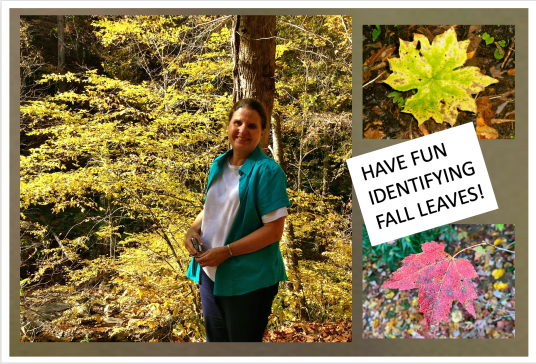
As a girl I learned to identify trees around my home and community with the help and instruction of my parents, school teachers, and scout leaders. Over time, however that knowledge has slipped a little, so I decided to pick up some tree identification guides and study some internet sites to refresh my knowledge. For my blog this month, with the trees still a glory, I thought you’d enjoy sharing in some of the knowledge I picked up about identifying trees from a distance and up close.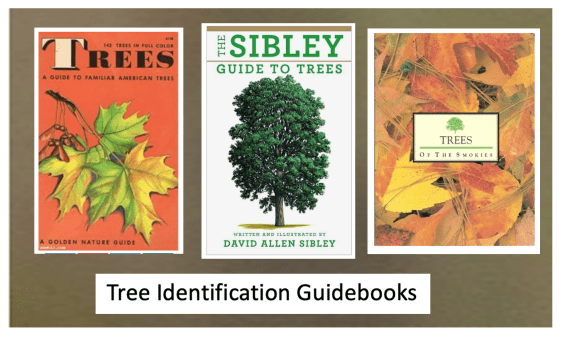
There are more than 20,000 different kinds of trees, making knowing and remembering them a challenge even for experts. Trees come in three main types: (1) Coniferous or evergreens, (2) Tropical like palms, and (3) Broadleaf, most of which are deciduous and shed their leaves in fall. It is the colorful Broadleaf Deciduous trees we see spread across our fall landscapes. Their leaves are flat and broadly shaped in a variety of sizes and patterns. A few reminders are helpful in knowing how to recognize and identify different trees.
First, all tree leaves are either “Simple”, with one single leaf, or “Compound” with multiple leaflets branching off the same stem. Redbuds are” simple” leaf tree with a simple recognizable heart shaped leaf. In fall, they turn yellow, making them easy to recognize up close. Cherry tree leaves are “simple” leaves, too. There are about 14 species of cherry trees found in the U.S. Most flower and fruit in spring and their leaves turn yellow and yellow-orange in the fall. In contrast, Sumac trees are a good example of “compound” leafed trees, with several leaflets on their stem. In fall they turn bright red and are often one of the earliest trees to turn. Hickory trees have alternate and “compound” leaves, too, with five to seven leaflets and the trees bear hickory nuts. Up close, some tree leaves are “Smooth Edged” or entire, around their sides, while others are zig-zagged or “Tooth Edged.” Dogwood trees and Crabapple trees, familiar to most, are good examples of “smooth-edged” trees, although the Crabapples do have tiny teeth around their edges. Beech trees are a more obvious example of “tooth-edged” trees. There are several different types of Beech trees but the American Beech is particularly stately and beautiful, often growing into a tall, giant of a tree. Elm trees, too, are “tooth-edged” trees and the well-known American Elm is often a large shade tree with wide spreading branches. The elms and beech in our neighborhood turn a golden yellow and then brown.
 After you begin to study more about tree leaves, you will find that many are recognizable in the fall not only by their color but by their shape. Also, some trees have different shaped leaves on different varieties, like on Sassafras trees. In our neighborhood is a giant red-leafed Sassafras with long simple leaves with no lobes. It turns crimson red in the fall. Also in the neighborhood is a Sassafras tree with three-lobed simple leaves. This shorter sycamore tree’s leaves turn a rich yellow in the fall. I often think these sycamore leaves look sort of like mittens in shape and often the leaves only have two lobes instead of three, looking even more like a mitten.
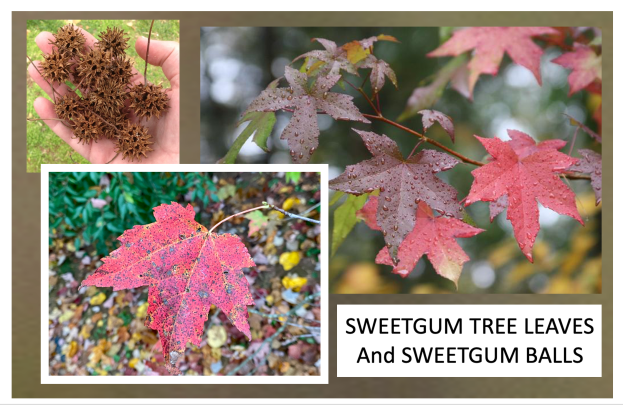
 Often you can recognize trees not only by their leaves but by their nuts, seeds, or berries. The Sweetgum tree is one of those. Its pointed lobed and toothed leaves are somewhat star-shaped. Sweetgum leaves turn red and purplish-red in fall and you can often find the tree’s round, spiny “sweet gum balls” nearby, the tree’s fruit, containing the seed. Young Sweetgum trees don’t produce Sweetgum balls at first but the trees start producing them later as they age.
 The Chestnut tree not only has distinctive leaves, easy to identify, but it produces sticky “Chestnut Burrs” in fall. The leaves on a Chestnut tree are often big, too, like magnolia leaves. My neighbor has a big Chestnut tree in her back yard and it’s her hand you see in the photo holding one of the tree’s burrs.
Many trees have berries, making them easier to identify. The Serviceberry tree, a small deciduous tree often called Shadbush, has white blossoms in spring, followed by pretty red fruits popular with birds. In the fall its leaves turn a brilliant, showy red orange. The Hackberry, a relative of the elm, comes in many different species. Its leaves turn yellow in the fall and its small, hard purple fruits are enjoyed by birds and wildlife.
One of the most common trees across the fall landscape is the Oak tree. Oak trees come in a multitude of varieties and kinds but most are easily recognized as oaks by their “lobed “leaves with rounded or pointed projections. The deep lobes on many Oaks, around a central stalk, almost look like a feather or a set of fingers. Oaks turn many colors, depending on type –bright red, crimson, yellow-orange, deep dark orange, and various shades of gold and yellow. Big trees, Oaks usually stand out in the fall landscape, and Oaks make up one of the largest groups of native trees in the United States with 50-75 species, mainly in the East. They have a distinctive fruit we all know as the “acorn.” The White Oak is probably the best-known Oak, turning a glorious orange in fall.
The other best-known tree in the autumn landscape is the Maple tree. There are over 60-80 species of this beloved tree in the U.S. and the lobed projections of most Maple trees are more pointed than most oak leaves. According to each Maple tree variety, the leaves can turn shades of yellow, orange, or red in the fall and blanket the ground in rich color. In spring Maples produce a winged seed we always called “helicopters” when I was growing up because of how they whirl and swirl down from the tree. Possibly the best-known Maple is the big, rounded Sugar Maple, which turns a rich golden yellow orange in the fall and usually stands out from the trees around it. Large red and yellow Maples catch our attention in the landscape, too.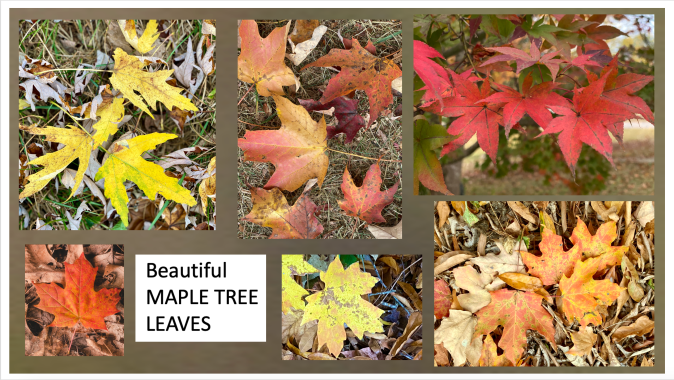
A tree I love in the fall landscape … and in my own backyard, too… is the beautiful, often towering, Tulip Poplar, which is also Tennessee’s State Tree. A common, big, straight-growing tree, it has leaves that are easy to recognize because they form a “tulip” shape, somewhat flat across the top with two side lobes. The tree produces pretty greenish-yellow flowers in spring, followed by cone-shaped fruit clusters, and in the fall the leaves turn a rich yellow, gradually deepening to yellow orange. In the parks around our home, and in the Smokies, the Tulip Poplar trees often create a yellow wonderland to hike through in the fall, often growing thickly together.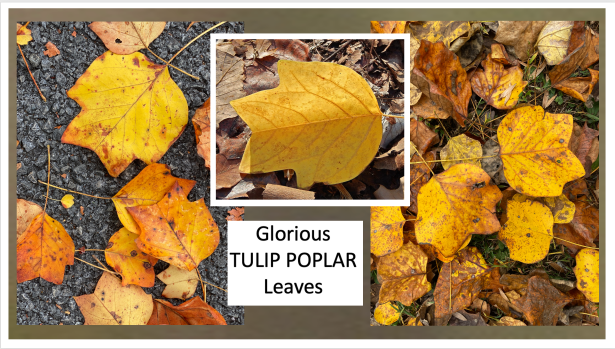 Two less common trees to watch for in the fall landscape are the yellow Gingko tree, with its green leaves gradually turning a vibrant yellow and the Red Dawn tree, sometimes called the Dawn Redwood tree, a deciduous tree with leaves that look much like an evergreen Christmas tree. The Ginkgo tree, also native to East Asia, is one of the oldest known living tree species in the world. The leaves have a distinctive “fan” shape, making it easily recognizable. I remember several beautiful Gingko trees on the University of Tennessee campus and we are blessed to have a lovely Gingko in our neighborhood, a beauty of yellow color right now. Another very old tree, you might spot because of its unique leaflets, is the Dawn Redwood. My neighbor has one in her yard and as fall wanes it turns a gorgeous orange. This tree is actually now an endangered species and like many redwoods can grow to a great height.
 As you look out across the hillsides at the fall colors, when you’re stopped along the way or driving, many of the yellow trees you see are most likely to be beech, birch, and yellow tulip poplars, while the lush rich orange and yellow-orange trees you spot are probably sugar maples, oaks and sweetgums. The reds scattered and clumped on the hillsides may be mainly maples, dogwoods, sassafras, and oaks. The colors of fall are always a delight and I love knowing that I’ll know more now about what kind of tree I’m seeing as I enjoy them. To learn more about the trees near your home, pick up a “tree guidebook” to help you identify the trees you see, read about identifying trees on the internet, and possibly download one of the “tree identification” apps to help you learn more about the trees in your fall landscape….And enjoy the fall!
Happy November. See you next month! … Lin
Note: All photos my own, from royalty free sites, or used only as a part of my author repurposed storyboards shown only for educational and illustrative purposes, acc to the Fair Use Copyright law, Section 107 of the Copyright Act.
 Lin Stepp