 On July 8th, J.L.’s and my fourth regional guidebook publishes, titled VISITING NORTH CAROLINA STATE PARKS. As with our two other state parks books, J.L. and I visited every single state park in the state to write this new book. We started our journey on North Carolina’s Atlantic coast and worked our way gradually west in week long trips. We had a glorious time visiting and exploring every park so we could share all the fun things to do and see in each one with our readers … lakes to enjoy, trails to hike, campgrounds and amenities available, historic spots not to miss, and much more. We also added the NC national parks and historic sites in our book, too. In many other states, like in Tennessee, these are governed by the state parks system …and they were too pretty to leave out of our guidebook! We delighted in journeying across the state over the last two years, and I hope you will enjoy reading our new guidebook and planning some trips of your own.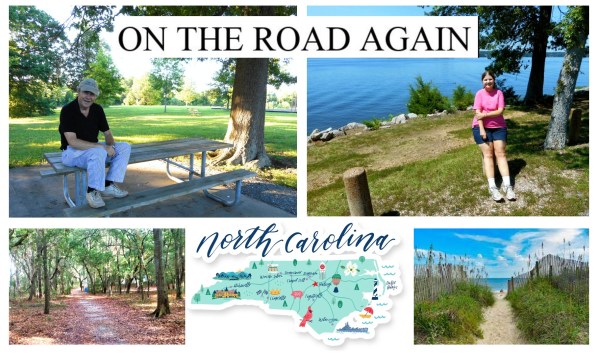
We laid out our North Carolina parks guidebook in four main sections: (1) The Tidewater area near the state’s coast; (2) The Coastal Plain area, moving west from the coast; (3) The Piedmont in the center of the state; and last (4) The Mountains Region in western North Carolina. We researched each section in general and then each park individually, planning our trips before setting out. We read extensively about historic sites, hiking trails, park history, and especially about unique features we didn’t want to miss on our visits.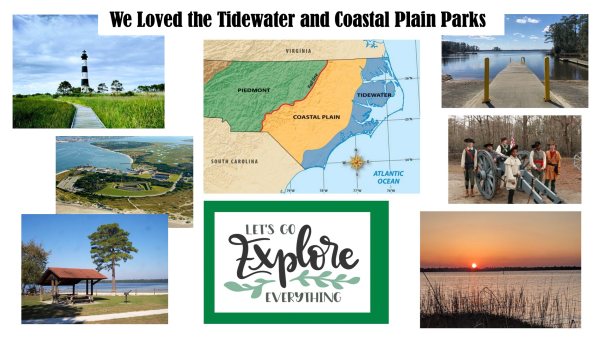
In North Carolina with the 42 state parks and 12 national parks so spread out, we traveled more getting from one park to the next, staying in motels or lodges we scouted out in advance. J.L. and I usually visited two state parks each day on our trips and occasionally, when the parks were small and near each other, we could visit three before dark began to fall. We seldom needed a fancy place to stay while traveling since after walking, hiking, and exploring out-of-doors all day we were usually happy to fall into whatever bed we found!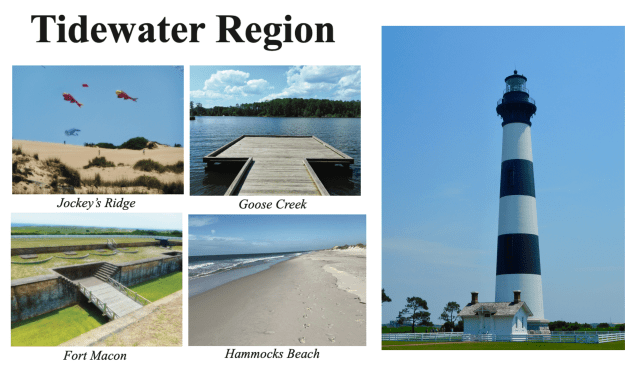
On our first trip, of nearly two weeks, we visited all the Tidewater Area along North Carolina’s coast. It had been years since J.L. and I had been to the North Carolina coast and the Outer Banks area. We stayed in a charming historic town called Edenton on the Albemarle Sound as our first base camp and from there visited many parks before moving south. In all, we explored twelve Tidewater parks including Fort Raleigh on Manteo, Jockey’s Ridge on the Atlantic Ocean, Cape Hatteras and Cape Lookout, Carolina Beach State Park, the Wright Brothers National Memorial, Fort Fisher, Moores Creek National Battleground, Fort Macon, and Hammocks Beach, plus inland parks like Goose Creek and Pettigrew. I was shocked at the tourism growth on the Outer Banks but we loved the National Seashores and the lighthouses we visited along the way. J.L. and I both learned a lot about the Revolutionary War visiting Confederate forts like Fort Fisher at Kure Beach, Fort Macon on Atlantic Beach, and Moores Creek battlefield inland at Currie.
Our next travel trip to North Carolina took us traveling inland from the ocean to the Coastal Plain Region. There we visited another eleven state parks scattered from north to south. Many of these parks centered around lakes, rivers, or swamps in lowland areas, while others took us into mountainous regions to hike steep trails to waterfalls and lovely views. The Coastal Plain parks we visited were Dismal Swamp, Merchants Millpond, Carvers Creek, Raven Rock, Cliffs of the Neuse, Lake Waccamaw, Weymouth Woods, Lumber River, Medoc Mountain, Jones Lake, and Singletary Lake. We enjoyed learning about the unusual Carolina bays, or shallow round lakes, typical in this region, many thought to be 10,000 to 15,000 years old. Because the lakes are shallow, you can walk far out into the the lake to play in the water – which gave us a shock the first time we saw swimmers standing in the middle of the lake! In contrast, mountainous parks like Raven Rock reminded us of the Smoky Mountains near our home.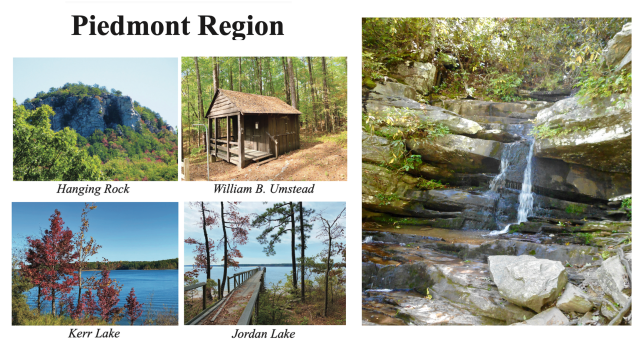
North Carolina’s Piedmont Region sprawls across most of the middle of the state and we visited thirteen parks there during two travel visits. Many of the parks centered around glorious lakes with vast acreage like Kerr Lake, Falls Lake, Jordan Lake and Lake Norman. Others celebrated rivers or cites on rivers like Eno River, Haw River, and May River. We found William B. Umstead State Park right in the middle of busy Raleigh and Guilford Courthouse Military Park in Greensboro. Showing us the diversity of the area, other parks sat in mountainous areas like the small Occoneechee Mountain park, Morrow Mountain in the Uwharrie Mountains, Hanging Rock State Park in the Sauratown Mountains, and Crowders Mountain nestled among the craggy peaks of The Pinnacle and high Crowders Mountain. These latter parks had many steep trails winding to stunning overlooks. 
Moving on to the Mountains Region, closer to our home in Tennessee, we discovered another broad array of parks to enjoy. Here among the eighteen parks we visited, on several trips in fall and spring, we explored not only state parks but many national parks and historic trails and sites. In the northern area of this region we visited high Pilot Mountain, Mount Jefferson, Rendezvous Mountain, Stone Mountain, New River State Park, and Elk Knob. Stone Mountain State Park was especially interesting with so many things to do and see, beautiful trails to hike, a gorgeous lake, waterfalls, and more. 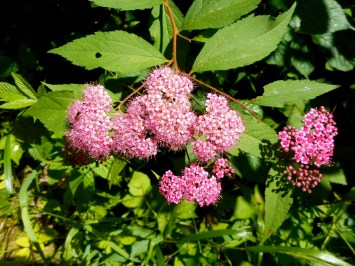 While in this upper region we visited points on the Overmountain Victory Trail, the Appalachian Trail, and then drove much of the beautiful Blue Ridge Parkway – a National Parkway with stunning points and views all along its route. We visited Mount Mitchell State Park while high on the Parkway, one of our favorite parks in North Carolina, and also went to both sections of Grandfather Mountain State Park. Moving south we enjoyed Lake James State Park, a large park with two unique sections and lots of camping, South Mountains, Carl Sandburg’s national historic site, and Chimney Rock State Park not far from Lake Lure, another favorite on our travels. Starting into the far western region of North Carolina we visited Gorges State Park, hiking the trails and seeing the waterfalls, and then moved on to finish our travels checking out points on the Trail of Tears National Historic Trail and exploring North Carolina sections of the Great Smoky Mountains National Park and the end of the Blue Ridge Parkway near Cherokee.
All in all, it was a great adventure, and we can truly say we know much more of the state of North Carolina, its cities, parks, and history than we did before. So often visiting the parks takes you back into less populated, beautiful parts of a state you might normally miss and not visit on a trip. The parks are seldom crowded like other major tourist areas so you can take your time exploring without worrying about traffic or crowds. And there is such beautiful scenery in our state and national parks. How blessed we are to have them preserved and saved for our joy and pleasure.
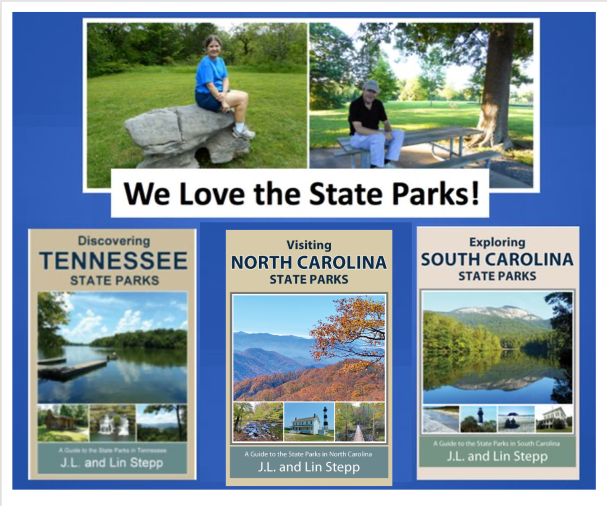 J.L. and I love the state parks. We have visited all the parks in our home state of Tennessee and in South Carolina and North Carolina now … and I imagine we’ll soon be ready to start visits to yet another nearby state. We hope you’ll enjoy our brand new North Carolina guidebook … and our past books, too, if you’ve missed them. Summer is a wonderful time to visit the parks when the weather is warm, when the grass and trees lush and green, and the days long,
Order our new NC book through any of your favorite bookstores or online at your favorite Indie store, Barnes & Noble, or at Amazon. If you want an autographed copy, you can also order our North Carolina guidebook or any of our guidebooks or my novels on our Online bookstore at: https://linstepp.com/order-autographed-books/
And remember John Muir’s wise words: “In every walk with nature one receives far more than he seeks.”
See you in August… Lin
Note: All photos my own, from royalty free sites, or used only as a part of my author repurposed storyboards shown only for educational and illustrative purposes, acc to the Fair Use Copyright law, Section 107 of the Copyright Act.
 Lin Stepp
Sounds wonderful!!
LikeLike